



Question: 3. Suppose we have a data set with the following three observations, each of which appears as a pair (x,y): (x1 = 5;y1 =
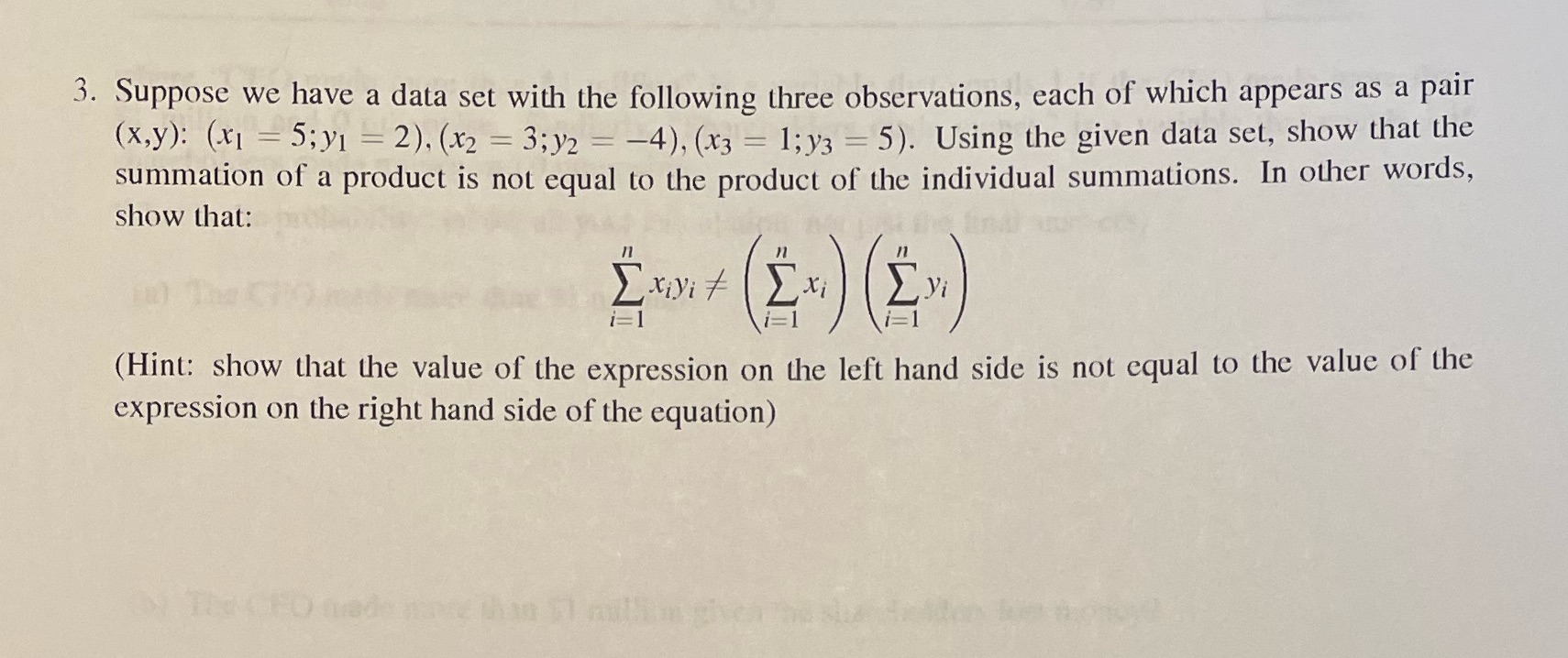
3. Suppose we have a data set with the following three observations, each of which appears as a pair (x,y): (x1 = 5;y1 = 2), (x2 = 3; y2 = -4), (x3 = 1; y3 = 5). Using the given data set, show that the summation of a product is not equal to the product of the individual summations. In other words, show that: * (**) (**) i=1 (Hint: show that the value of the expression on the left hand side is not equal to the value of the expression on the right hand side of the equation)
Step by Step Solution
There are 3 Steps involved in it
1 Expert Approved Answer
Step: 1 Unlock

Question Has Been Solved by an Expert!
Get step-by-step solutions from verified subject matter experts
Step: 2 Unlock
Step: 3 Unlock