Question: 3. Suppose you created Figure 1 using Microsoft Excel. To do so, you keyed the data into Excel and clicked the Make Graph button (there
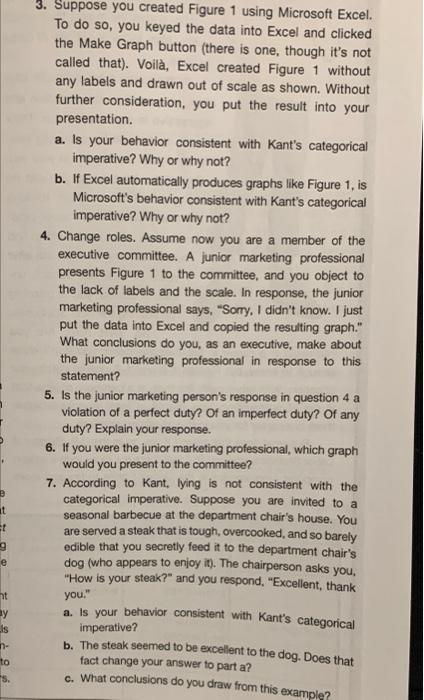
3. Suppose you created Figure 1 using Microsoft Excel. To do so, you keyed the data into Excel and clicked the Make Graph button (there is one, though it's not called that). Voil, Excel created Figure 1 without any labels and drawn out of scale as shown. Without further consideration, you put the result into your presentation. a. Is your behavior consistent with Kant's categorical imperative? Why or why not? b. If Excel automatically produces graphs like Figure 1. is Microsoft's behavior consistent with Kant's categorical imperative? Why or why not? 4. Change roles. Assume now you are a member of the executive committee. A junior marketing professional presents Figure 1 to the committee, and you object to the lack of labels and the scale. In response, the junior marketing professional says, "Sorry, I didn't know. I just put the data into Excel and copied the resulting graph." What conclusions do you, as an executive, make about the junior marketing professional in response to this statement? 5. Is the junior marketing person's response in question 4 a violation of a perfect duty? Of an imperfect duty? of any duty? Explain your response. 6. If you were the junior marketing professional, which graph would you present to the committee? 7. According to Kant, lying is not consistent with the categorical imperative. Suppose you are invited to a seasonal barbecue at the department chair's house. You are served a steak that is tough, overcooked, and so barely edible that you secretly feed it to the department chair's dog (who appears to enjoy it). The chairperson asks you, "How is your steak?" and you respond, "Excellent, thank you." a. Is your behavior consistent with Kant's categorical imperative? b. The steak seemed to be excellent to the dog. Does that fact change your answer to parta? c. What conclusions do you draw from this example? B it Et 9 e ht y Is n- to 5. 3. Suppose you created Figure 1 using Microsoft Excel. To do so, you keyed the data into Excel and clicked the Make Graph button (there is one, though it's not called that). Voil, Excel created Figure 1 without any labels and drawn out of scale as shown. Without further consideration, you put the result into your presentation. a. Is your behavior consistent with Kant's categorical imperative? Why or why not? b. If Excel automatically produces graphs like Figure 1. is Microsoft's behavior consistent with Kant's categorical imperative? Why or why not? 4. Change roles. Assume now you are a member of the executive committee. A junior marketing professional presents Figure 1 to the committee, and you object to the lack of labels and the scale. In response, the junior marketing professional says, "Sorry, I didn't know. I just put the data into Excel and copied the resulting graph." What conclusions do you, as an executive, make about the junior marketing professional in response to this statement? 5. Is the junior marketing person's response in question 4 a violation of a perfect duty? Of an imperfect duty? of any duty? Explain your response. 6. If you were the junior marketing professional, which graph would you present to the committee? 7. According to Kant, lying is not consistent with the categorical imperative. Suppose you are invited to a seasonal barbecue at the department chair's house. You are served a steak that is tough, overcooked, and so barely edible that you secretly feed it to the department chair's dog (who appears to enjoy it). The chairperson asks you, "How is your steak?" and you respond, "Excellent, thank you." a. Is your behavior consistent with Kant's categorical imperative? b. The steak seemed to be excellent to the dog. Does that fact change your answer to parta? c. What conclusions do you draw from this example? B it Et 9 e ht y Is n- to 5









 Study Help