







Question: 3. Suppose you have one continuous predictor X and a binary categorical re- sponse Y, which can take values 1 or 2. Suppose you collected
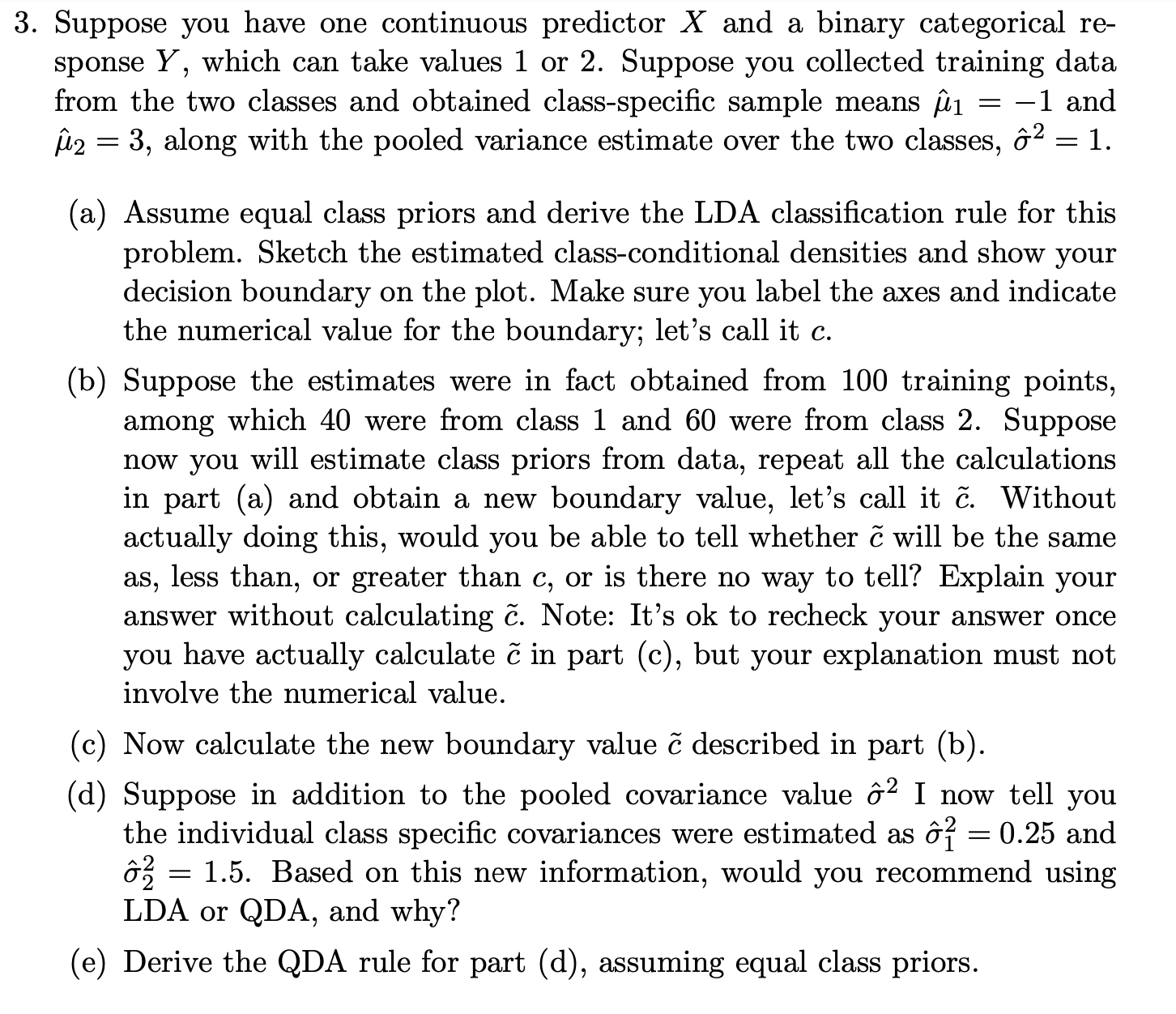
3. Suppose you have one continuous predictor X and a binary categorical re- sponse Y, which can take values 1 or 2. Suppose you collected training data from the two classes and obtained class-specic sample means [11 = 1 and ag = 3, along with the pooled variance estimate over the two classes, 62 = 1. (a) (6) Assume equal class priors and derive the LDA classication rule for this problem. Sketch the estimated class-conditional densities and show your decision boundary on the plot. Make sure you label the axes and indicate the numerical value for the boundary; let's call it (2. Suppose the estimates were in fact obtained from 100 training points, among which 40 were from class 1 and 60 were from class 2. Suppose now you will estimate class priors from data, repeat all the calculations in part (a) and obtain a new boundary value, let's call it E. Without actually doing this, would you be able to tell whether 5 will be the same as, less than, or greater than c, or is there no way to tell? Explain your answer without calculating 5. Note: It's ok to recheck your answer once you have actually calculate 5 in part (c), but your explanation must not involve the numerical value. Now calculate the new boundary value 5 described in part (b). Suppose in addition to the pooled covariance value 62 I now tell you the individual class specic covariances were estimated as 6% = 0.25 and 62 = 1.5. Based on this new information, would you recommend using LDA or QDA, and why? Derive the QDA rule for part ((1), assuming equal class priors
Step by Step Solution
There are 3 Steps involved in it

Get step-by-step solutions from verified subject matter experts
 Study Help