







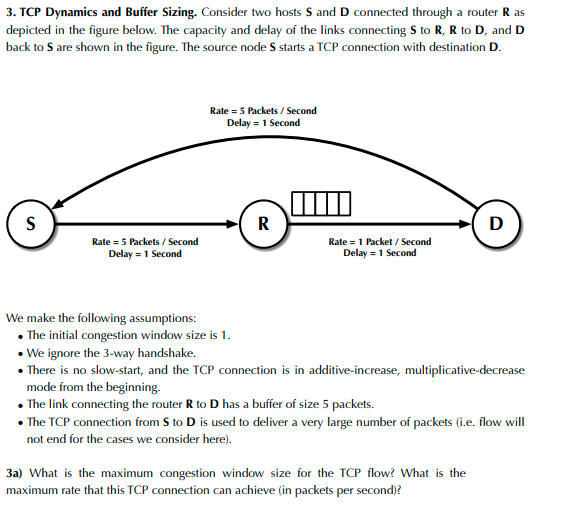
Question: 3 . TCP Dynamics and Buffer Sizing. Consider two hosts ( mathbf { S } ) and ( mathbf {
TCP Dynamics and Buffer Sizing. Consider two hosts mathbfS and mathbfD connected through a router mathbfR as depicted in the figure below. The capacity and delay of the links connecting mathbfS to mathbfRmathbfR to mathbfD and mathbfD back to mathbfS are shown in the figure. The source node mathbfS starts a TCP connection with destination mathbfD
We make the following assumptions:
The initial congestion window size is
We ignore the way handshake.
There is no slowstart, and the TCP connection is in additiveincrease, multiplicativedecrease mode from the beginning.
The link connecting the router mathbfR to mathbfD has a buffer of size packets.
The TCP connection from mathbfS to mathbfD is used to deliver a very large number of packets ie flow will not end for the cases we consider here
a What is the maximum congestion window size for the TCP flow? What is the maximum rate that this TCP connection can achieve in packets per second
Step by Step Solution
There are 3 Steps involved in it
1 Expert Approved Answer
Step: 1 Unlock

Question Has Been Solved by an Expert!
Get step-by-step solutions from verified subject matter experts
Step: 2 Unlock
Step: 3 Unlock
 Study Help