





Question: 3 The answer to part b 2. How Much to Order (determining unconstrained EOQ, total annual costs with EOQ, and comparing to annual costs of

3

The answer to part b
3 The answer to part b 2. How Much to Order
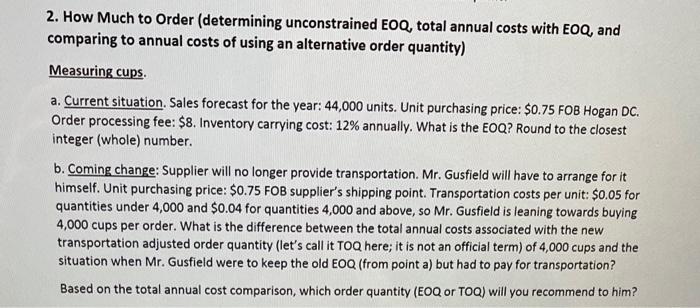
2. How Much to Order (determining unconstrained EOQ, total annual costs with EOQ, and comparing to annual costs of using an alternative order quantity) Measuring cups. a. Current situation. Sales forecast for the year: 44,000 units. Unit purchasing price: $0.75 FOB Hogan DC. Order processing fee: $8. Inventory carrying cost: 12% annually. What is the EOQ? Round to the closest integer (whole) number. b. Coming change: Supplier will no longer provide transportation. Mr. Gusfield will have to arrange for it himself. Unit purchasing price: $0.75 FOB supplier's shipping point. Transportation costs per unit: $0.05 for quantities under 4,000 and $0.04 for quantities 4,000 and above, so Mr. Gusfield is leaning towards buying 4,000 cups per order. What is the difference between the total annual costs associated with the new transportation adjusted order quantity (let's call it TOQ here; it is not an official term) of 4,000 cups and the situation when Mr. Gusfield were to keep the old EOQ (from point a) but had to pay for transportation? Based on the total annual cost comparison, which order quantity (EOQ or TOO) will you recommend to him

Step by Step Solution

There are 3 Steps involved in it

1 Expert Approved Answer
Step: 1 Unlock blur-text-image

Question Has Been Solved by an Expert!

Get step-by-step solutions from verified subject matter experts

Step: 2 Unlock
Step: 3 Unlock

Students Have Also Explored These Related Accounting Questions!