



Question: 3. The example run of the exact solution for the traveling salesperson problem, given in the lecture notes, shows that many of the table cells

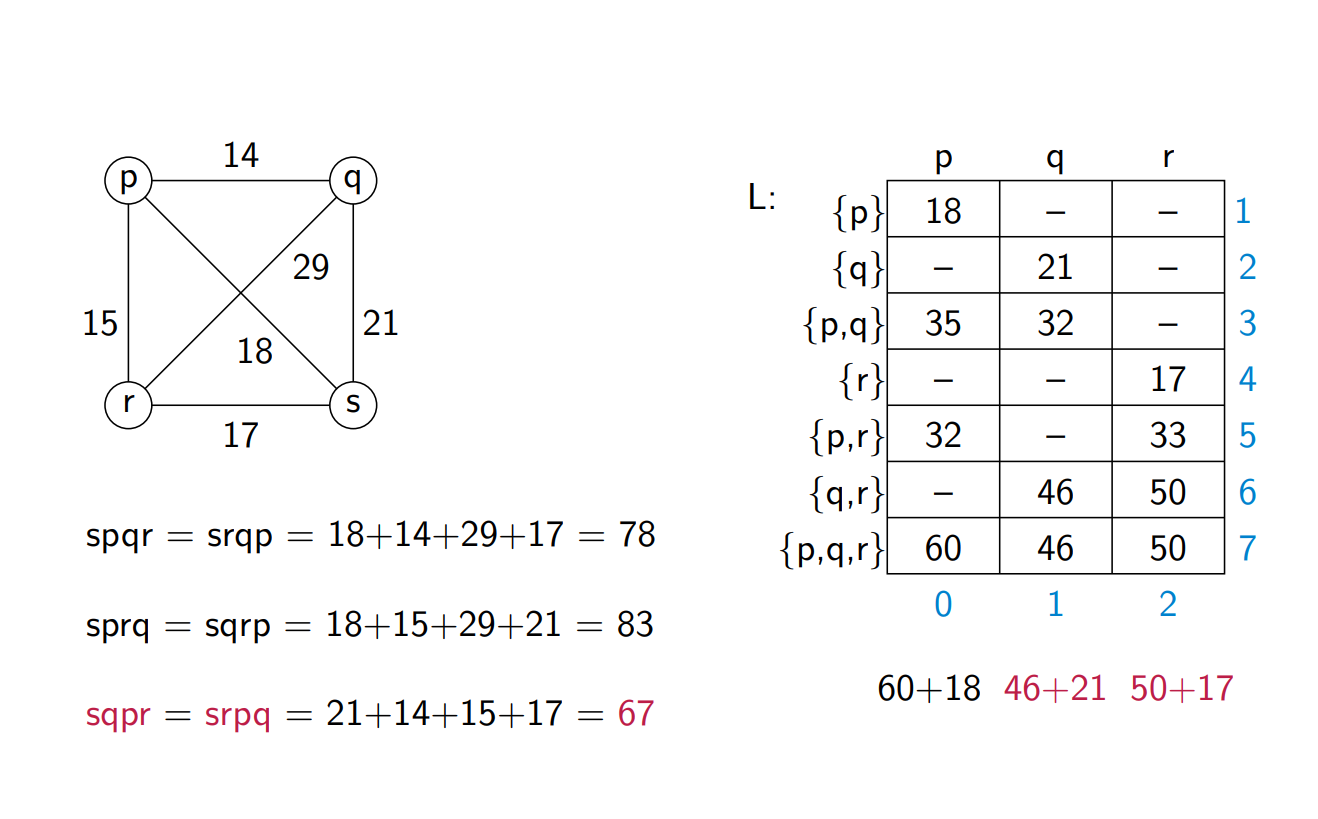
3. The example run of the exact solution for the traveling salesperson problem, given in the lecture notes, shows that many of the table cells are not filled in (shown as a dash), because the element corresponding to the cell column does not belong to the set corresponding to the cell row. In a problem with n vertices, the table would have n - 1 columns (because the start vertex is omitted), and 2n-1 1 rows (because the empty set is omitted). How many of the resulting (n 1)(2n-1 1) cells would be filled in, as a function of n? 14 q r q - 1 29 - 21 - 2 15 21 32 - 3 18 L: {p} 18 {q} {p,q} 35 {r} {p.r} 32 {q,r} {p,q,r} 60 0 17 4 S 17 33 5 46 50 6 spar = srap = 18+14+29+17 = 78 46 50 7 1 2 spra = sqrp - 18+15+29+21 = 83 60+18 46+21 50+17 sqpr = srpa = 21+14+15+17 = 67
Step by Step Solution
There are 3 Steps involved in it

Get step-by-step solutions from verified subject matter experts