







Question: 3. The system shown below has 3 planets and a star. Each planet executes an elliptical orbit around the star. a. Planet 2 has a
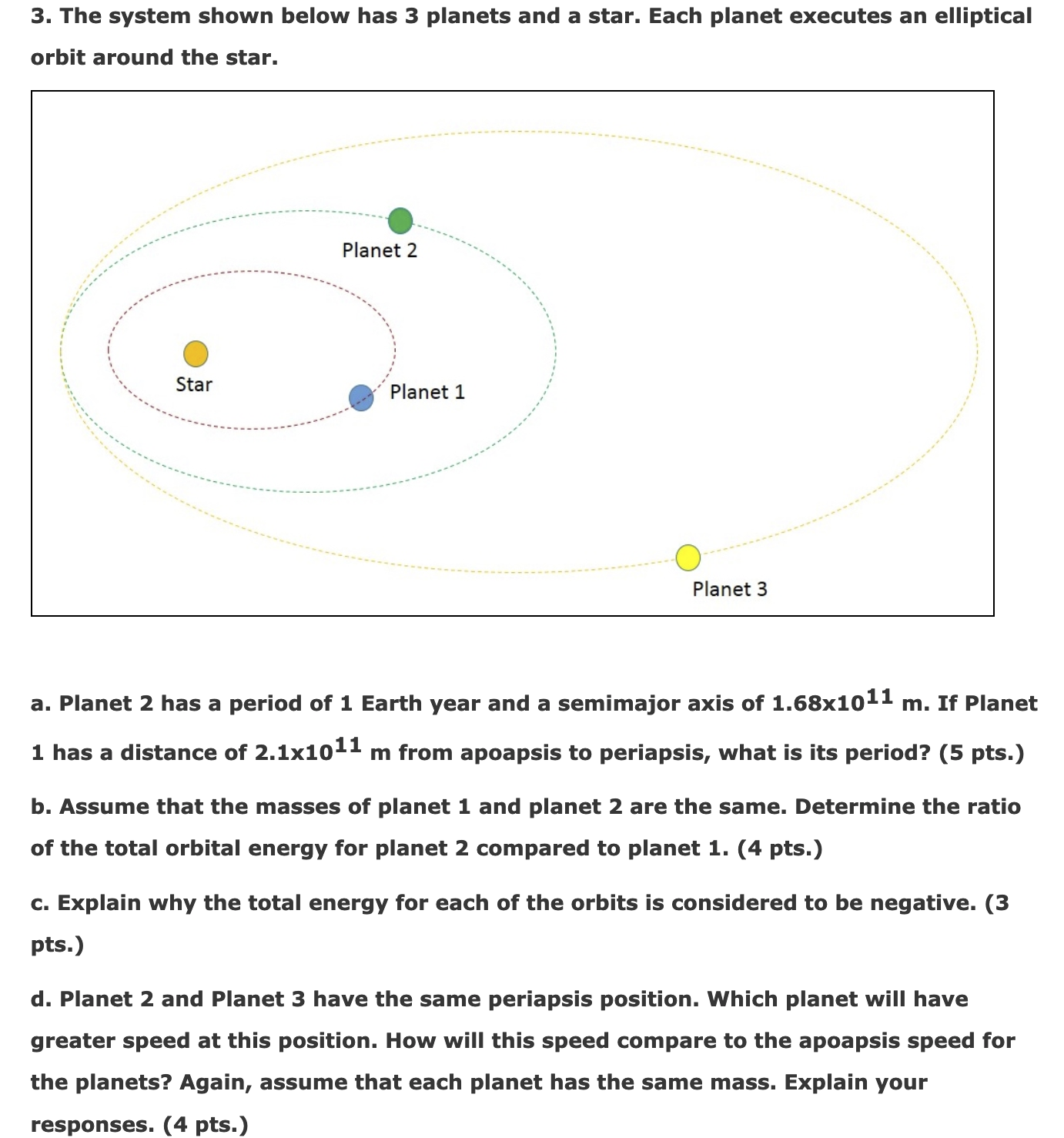
3. The system shown below has 3 planets and a star. Each planet executes an elliptical orbit around the star. a. Planet 2 has a period of 1 Earth year and a semimajor axis of 1.68x10¹¹ m. If Planet 1 has a distance of 2.1):1011 m from apoapsis to periapsis, what is its period? (5 pts.) b. Assume that the masses of planet 1 and planet 2 are the same. Determine the ratio of the total orbital energy for planet 2 compared to planet 1. (4 pts.) c. Explain why the total energy for each of the orbits is considered to be negative. (3 pts.) d. Planet 2 and Planet 3 have the same periapsis position. Which planet will have greater speed at this position. How will this speed compare to the apoapsis Speed for the planets? Again, assume that each planet has the same mass. Explain your responses. (4 pts.)
Step by Step Solution
There are 3 Steps involved in it

Get step-by-step solutions from verified subject matter experts
 Study Help