







Question: 3. The zeroth order cylindrical Bessel function has the Maclaurin series 2k 1 Jo(x) = (-1) (k!)2 k=0 N -1* 2.13 () * k=0 To
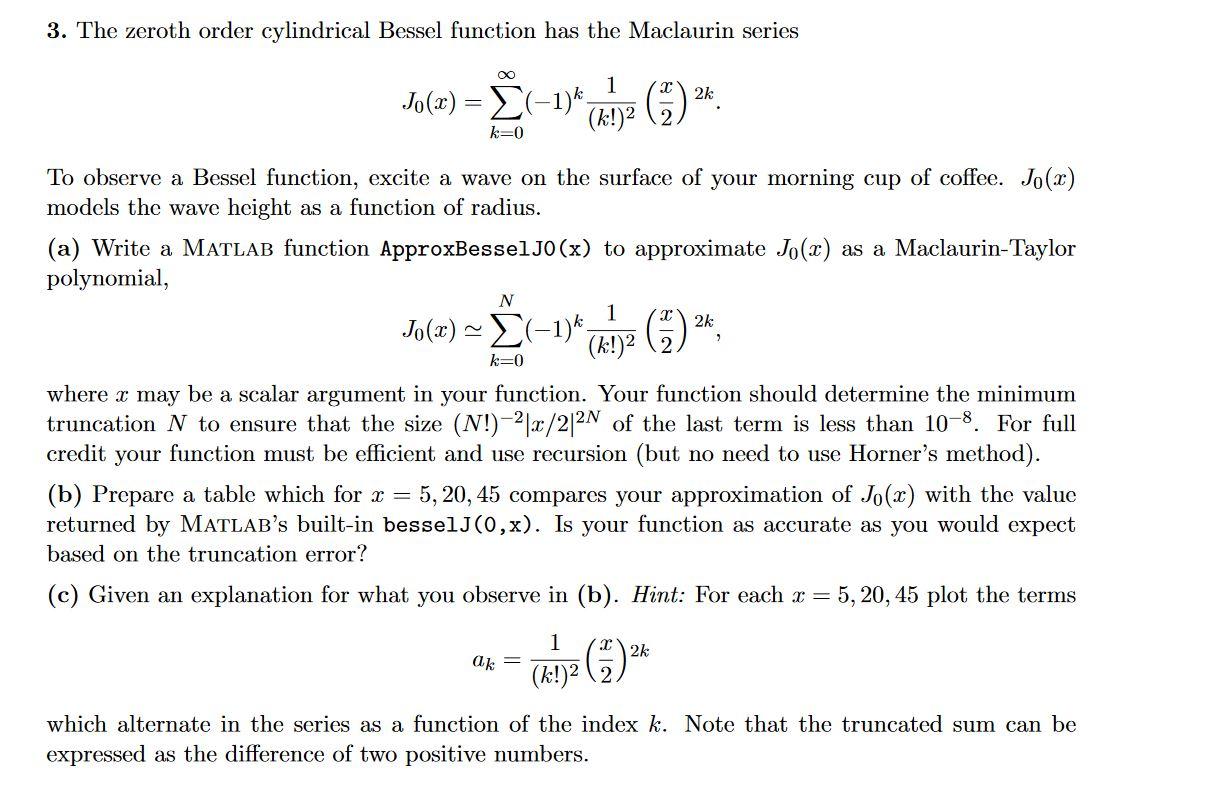
3. The zeroth order cylindrical Bessel function has the Maclaurin series 2k 1 Jo(x) = (-1) (k!)2 k=0 N -1* 2.13 () * k=0 To observe a Bessel function, excite a wave on the surface of your morning cup of coffee. Jo(x) models the wave height as a function of radius. (a) Write a MATLAB function ApproxBesselJ0(x) to approximate Jo(x) as a Maclaurin-Taylor polynomial, 1 Jo(x) (-1)", (k!) where x may be a scalar argument in your function. Your function should determine the minimum truncation N to ensure that the size (N!) -2|x/2/20 of the last term is less than 10-8. For full credit your function must be efficient and use recursion (but no need to use Horner's method). (b) Prepare a table which for x = 5, 20, 45 compares your approximation of Jo(c) with the value returned by MATLAB's built-in besselJ(0,x). Is your function as accurate as you would expect based on the truncation error? (c) Given an explanation for what you observe in (b). Hint: For each x = 5, 20, 45 plot the terms ak 1 2k (k!)2 (2 which alternate in the series as a function of the index k. Note that the truncated sum can be expressed as the difference of two positive numbers. 3. The zeroth order cylindrical Bessel function has the Maclaurin series 2k 1 Jo(x) = (-1) (k!)2 k=0 N -1* 2.13 () * k=0 To observe a Bessel function, excite a wave on the surface of your morning cup of coffee. Jo(x) models the wave height as a function of radius. (a) Write a MATLAB function ApproxBesselJ0(x) to approximate Jo(x) as a Maclaurin-Taylor polynomial, 1 Jo(x) (-1)", (k!) where x may be a scalar argument in your function. Your function should determine the minimum truncation N to ensure that the size (N!) -2|x/2/20 of the last term is less than 10-8. For full credit your function must be efficient and use recursion (but no need to use Horner's method). (b) Prepare a table which for x = 5, 20, 45 compares your approximation of Jo(c) with the value returned by MATLAB's built-in besselJ(0,x). Is your function as accurate as you would expect based on the truncation error? (c) Given an explanation for what you observe in (b). Hint: For each x = 5, 20, 45 plot the terms ak 1 2k (k!)2 (2 which alternate in the series as a function of the index k. Note that the truncated sum can be expressed as the difference of two positive numbers
Step by Step Solution
There are 3 Steps involved in it

Get step-by-step solutions from verified subject matter experts
 Study Help