







Question: 3) There are two lines in R3: Line / = (-4, 0, -1) + t(-3, 7, 8), Line m = (0, -9, 2) + s(6,
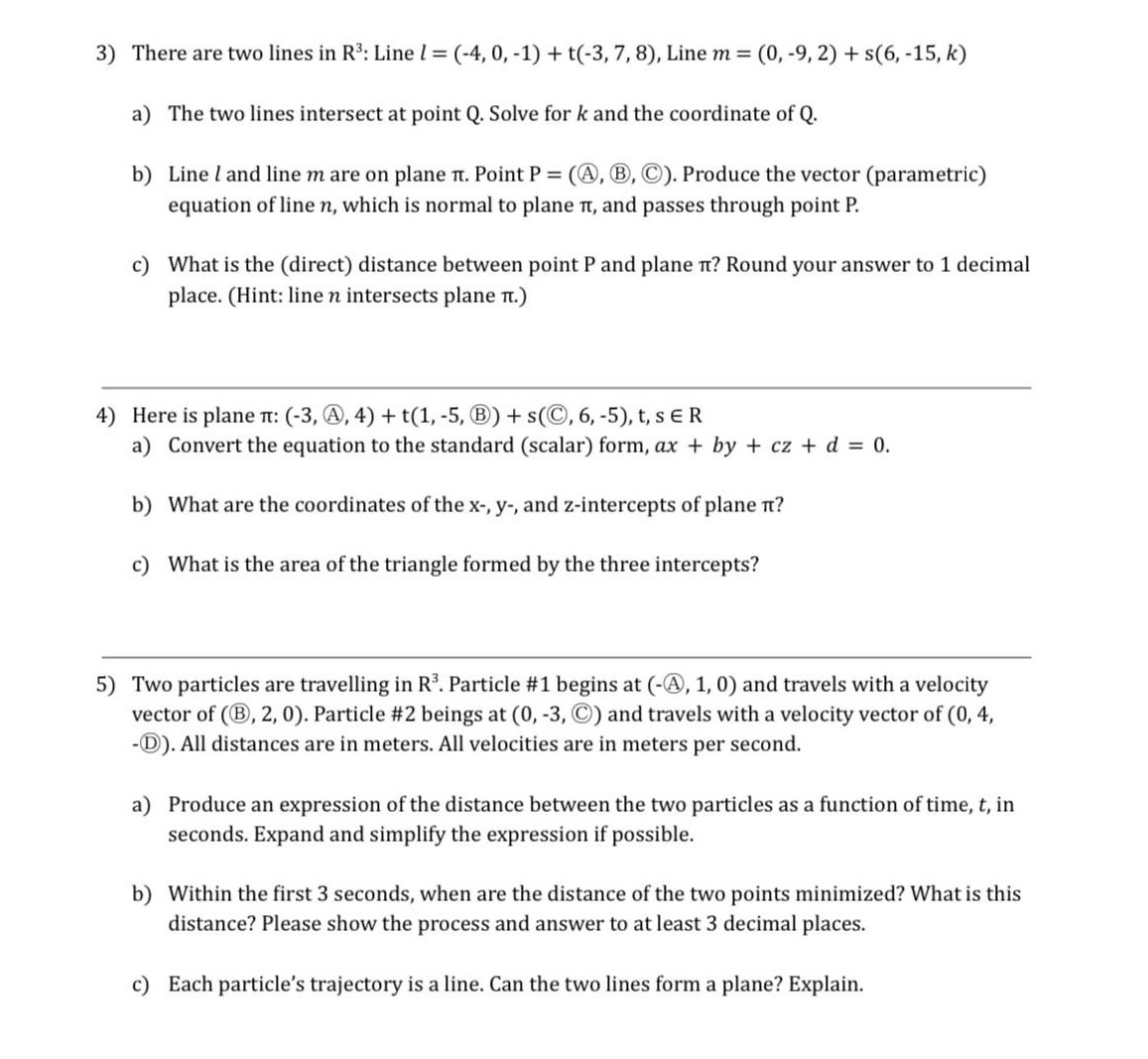
3) There are two lines in R3: Line / = (-4, 0, -1) + t(-3, 7, 8), Line m = (0, -9, 2) + s(6, -15, k) a) The two lines intersect at point Q. Solve for k and the coordinate of Q. b) Line / and line m are on plane nt. Point P = (A), B, C). Produce the vector (parametric) equation of line n, which is normal to plane , and passes through point P. c) What is the (direct) distance between point P and plane n? Round your answer to 1 decimal place. (Hint: line n intersects plane T.) 4) Here is plane n: (-3, A), 4) + t(1, -5, B) + s(C, 6, -5), t, SER a) Convert the equation to the standard (scalar) form, ax + by + cz + d = 0. b) What are the coordinates of the x-, y-, and z-intercepts of plane It? c) What is the area of the triangle formed by the three intercepts? 5) Two particles are travelling in R'. Particle #1 begins at (-A), 1, 0) and travels with a velocity vector of (B, 2, 0). Particle #2 beings at (0, -3, C) and travels with a velocity vector of (0, 4, -D). All distances are in meters. All velocities are in meters per second. a) Produce an expression of the distance between the two particles as a function of time, t, in seconds. Expand and simplify the expression if possible. b) Within the first 3 seconds, when are the distance of the two points minimized? What is this distance? Please show the process and answer to at least 3 decimal places. c) Each particle's trajectory is a line. Can the two lines form a plane? Explain.3) There are two lines in R3: Line / = (-4, 0, -1) + t(-3, 7, 8), Line m = (0, -9, 2) + s(6, -15, k) a) The two lines intersect at point Q. Solve for k and the coordinate of Q. b) Line / and line m are on plane nt. Point P = (A), B, C). Produce the vector (parametric) equation of line n, which is normal to plane , and passes through point P. c) What is the (direct) distance between point P and plane n? Round your answer to 1 decimal place. (Hint: line n intersects plane T.) 4) Here is plane n: (-3, A), 4) + t(1, -5, B) + s(C, 6, -5), t, SER a) Convert the equation to the standard (scalar) form, ax + by + cz + d = 0. b) What are the coordinates of the x-, y-, and z-intercepts of plane It? c) What is the area of the triangle formed by the three intercepts? 5) Two particles are travelling in R'. Particle #1 begins at (-A), 1, 0) and travels with a velocity vector of (B, 2, 0). Particle #2 beings at (0, -3, C) and travels with a velocity vector of (0, 4, -D). All distances are in meters. All velocities are in meters per second. a) Produce an expression of the distance between the two particles as a function of time, t, in seconds. Expand and simplify the expression if possible. b) Within the first 3 seconds, when are the distance of the two points minimized? What is this distance? Please show the process and answer to at least 3 decimal places. c) Each particle's trajectory is a line. Can the two lines form a plane? Explain
Step by Step Solution
There are 3 Steps involved in it

Get step-by-step solutions from verified subject matter experts
 Study Help