



Question: 3) This problem deals with translating from C to MIPS assembly. Assume that the variables f, g, h, i and j are assigned to registers
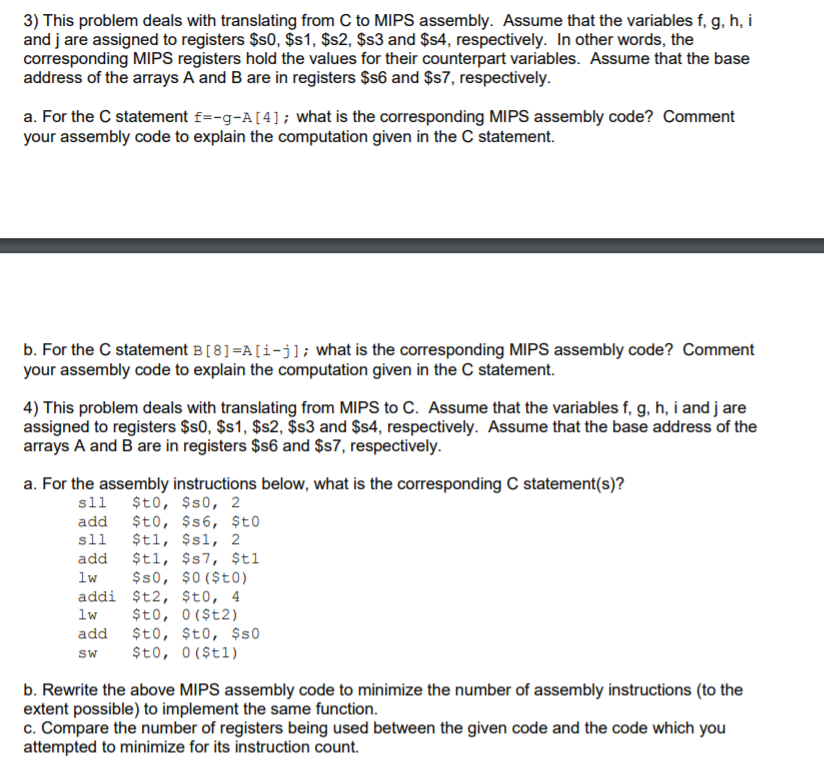
3) This problem deals with translating from C to MIPS assembly. Assume that the variables f, g, h, i and j are assigned to registers $s0, $s1, $s2, $s3 and $s4, respectively. In other words, the corresponding MIPS registers hold the values for their counterpart variables. Assume that the base address of the arrays A and B are in registers $s6 and $s7, respectively a. For the C statement f-g-A [4] what is the corresponding MIPS assembly code? Comment your assembly code to explain the computation given in the C statement. b. For the C statement B [8] A[i-jl: what is the corresponding MIPS assembly code? Comment your assembly code to explain the computation given in the C statement. 4) This problem deals with translating from MIPS to C. Assume that the variables f, g, h, i and j are assigned to registers $s0, $s1, $s2, $s3 and $s4, respectively. Assume that the base address of the arrays A and B are in registers $s6 and $s7, respectively a. For the assembly instructions below, what is the corresponding C statement(s)? sll $t0, $s0,2 add $t0, $s6, $t0 sll $tl, $s1, 2 add $tl, $S7, $t1 lw s0, $0 ($t0) addi $t2, $t0, 4 lw $t0, 0($t2) add $t0, $to, $s0 sw $t0, 0($t1) b. Rewrite the above MIPS assembly code to minimize the number of assembly instructions (to the extent possible) to implement the same function. c. Compare the number of registers being used between the given code and the code which you attempted to minimize for its instruction count
Step by Step Solution
There are 3 Steps involved in it

Get step-by-step solutions from verified subject matter experts