







Question: 3. This problem is inspired by the gender gap in earnings in top corporate jobs. The regressions are performed on data from top executives in

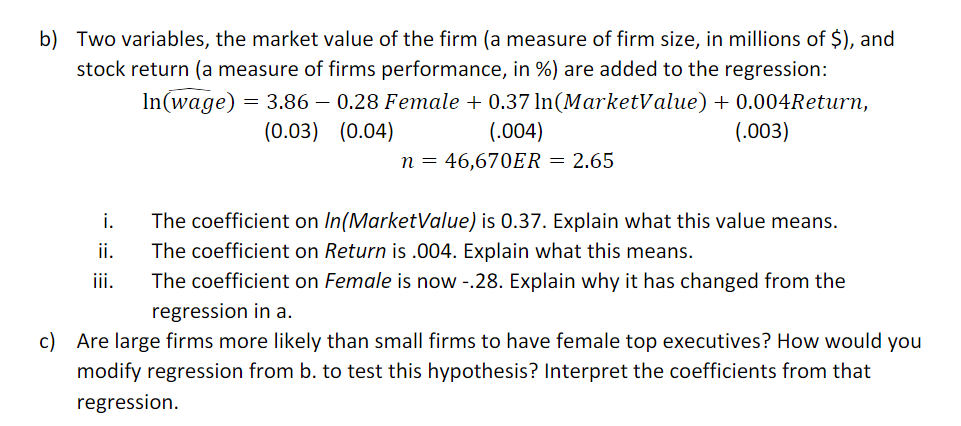
3. This problem is inspired by the gender gap in earnings in top corporate jobs. The regressions are performed on data from top executives in a large set of US public corporations. Each year these corporations must report total compensation levels for their top five executives. b) Two variables, the market value of the firm (a measure of firm size, in millions of $), and stock return (a measure of firms performance, in %) are added to the regression: In(wage) = 3.86 0.28 Female + 0.37 ln(MarketValue) + 0.004Return, (0.03) (0.04) 0.004) 0.003) n = 46,670ER = 2.65 i. The coefficient on In(MarketValue) is 0.37. Explain what this value means. ii. The coefficient on Return is .004. Explain what this means. iii. The coefficient on Female is now - 28. Explain why it has changed from the regression in a. c) Are large firms more likely than small firms to have female top executives? How would you modify regression from b. to test this hypothesis? Interpret the coefficients from that regression. 3. This problem is inspired by the gender gap in earnings in top corporate jobs. The regressions are performed on data from top executives in a large set of US public corporations. Each year these corporations must report total compensation levels for their top five executives. b) Two variables, the market value of the firm (a measure of firm size, in millions of $), and stock return (a measure of firms performance, in %) are added to the regression: In(wage) = 3.86 0.28 Female + 0.37 ln(MarketValue) + 0.004Return, (0.03) (0.04) 0.004) 0.003) n = 46,670ER = 2.65 i. The coefficient on In(MarketValue) is 0.37. Explain what this value means. ii. The coefficient on Return is .004. Explain what this means. iii. The coefficient on Female is now - 28. Explain why it has changed from the regression in a. c) Are large firms more likely than small firms to have female top executives? How would you modify regression from b. to test this hypothesis? Interpret the coefficients from that regression
Step by Step Solution
There are 3 Steps involved in it

Get step-by-step solutions from verified subject matter experts
 Study Help