



Question: 3. To measure gravitational time dilation, consider two static observers at different proper radial distances in a spherically symmetric, static gravitational eld. a) In (t,'r)
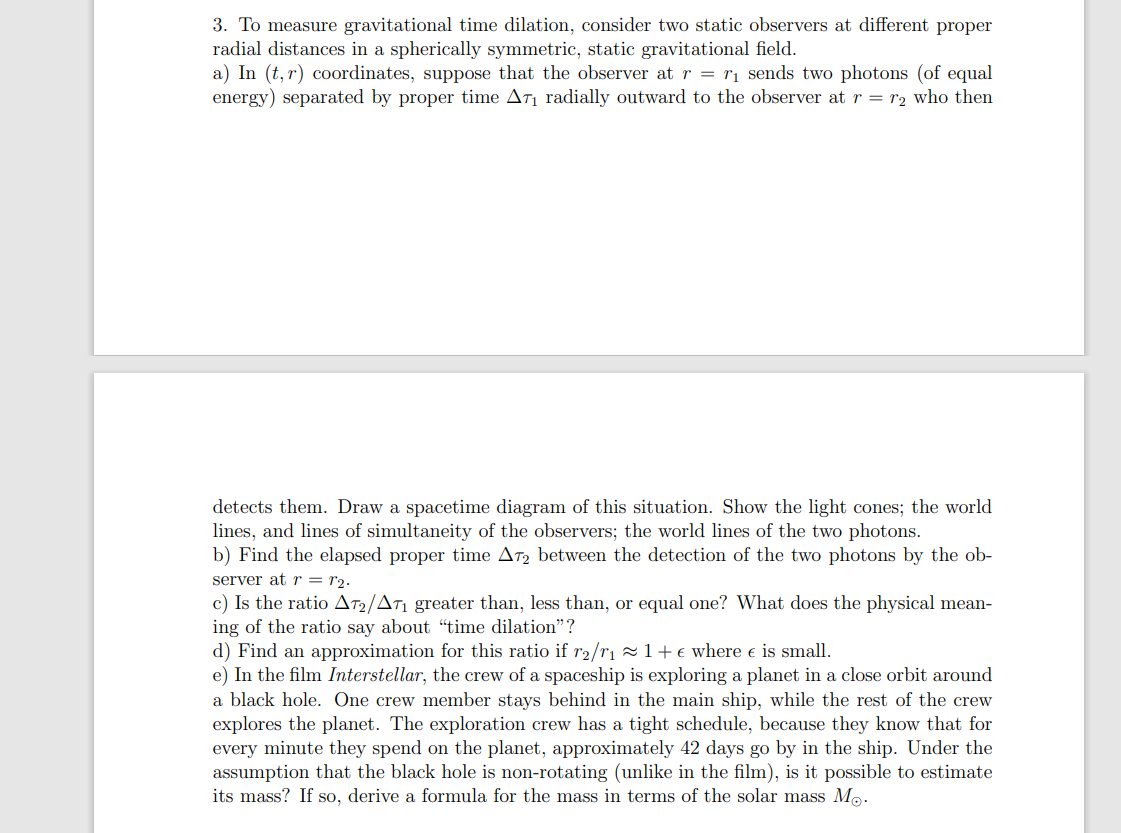
3. To measure gravitational time dilation, consider two static observers at different proper radial distances in a spherically symmetric, static gravitational eld. a) In (t,'r) coordinates suppose that the observer at r = r1 sends two photons (of equal energy) separated by proper time Ar] radially outward to the observer at r = 1"; who then detects them. Draw a spacetiIne diagram of this situation. Show the light cones; the world lines, and lines of simultaneity of the observers; the world lines of the two photons. b) Find the elapsed proper time 1313 between the detection of the two photons by the ob- server at r = r2. c) Is the ratio A72 / A71 greater than, less than, or equal one? What does the physical mean- ing of the ratio say about \"time dilation\"? d) Find an apprmdrnation for this ratio if 1'2 /*r1 z 1 + e where e is small. e) In the hn Interstellar, the crew of a spaceship is exploring a planet in a close orbit around a black hole. One crew member stays behind in the main ship, while the rest of the crew explores the planet. The exploration crew has a tight schedule, because they know that for every minute they spend on the planet, approximately 42 days go by in the ship. Under the assumption that the black hole is non-rotating (unlike in the lm), is it possible to estimate its mass? If so, derive a formula for the mass in terms of the solar Inass M9
Step by Step Solution
There are 3 Steps involved in it

Get step-by-step solutions from verified subject matter experts