





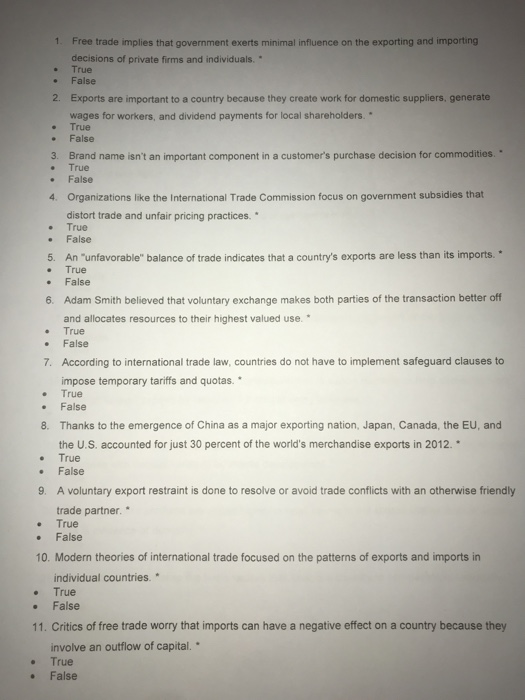
Question: . 3 . . True 1. Free trade implies that government exerts minimal influence on the exporting and importing decisions of private firms and individuals.
. 3 . . True 1. Free trade implies that
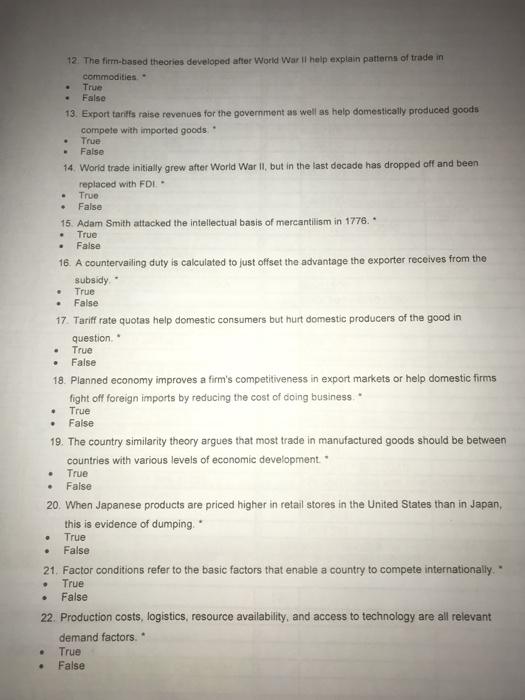
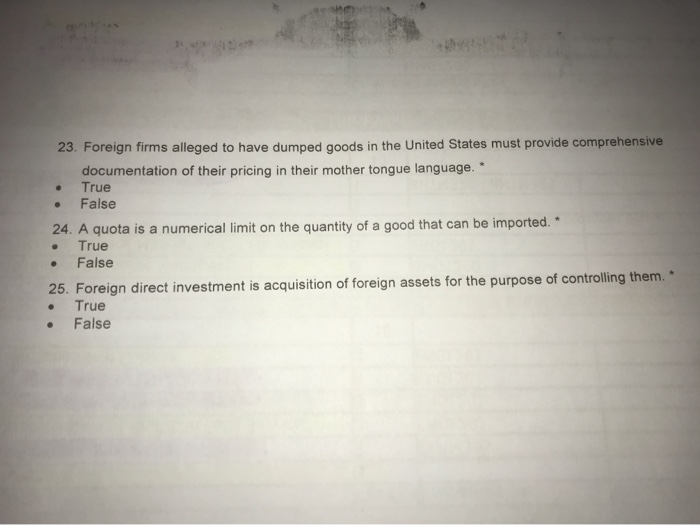
. 3 . . True 1. Free trade implies that government exerts minimal influence on the exporting and importing decisions of private firms and individuals. True False 2. Exports are important to a country because they create work for domestic suppliers, generate wages for workers, and dividend payments for local shareholders. True False Brand name isn't an important component in a customer's purchase decision for commodities True False 4. Organizations like the International Trade Commission focus on government subsidies that distort trade and unfair pricing practices. True False 5. An unfavorable" balance of trade indicates that a country's exports are less than its imports. False 6. Adam Smith believed that voluntary exchange makes both parties of the transaction better off and allocates resources to their highest valued use.* True False 7. According to international trade law, countries do not have to implement safeguard clauses to impose temporary tariffs and quotas. * True False 8. Thanks to the emergence of China as a major exporting nation, Japan, Canada, the EU, and the U.S. accounted for just 30 percent of the world's merchandise exports in 2012. True False 9. A voluntary export restraint is done to resolve or avoid trade conflicts with an otherwise friendly trade partner. * True . . . . . . . False 10. Modern theories of international trade focused on the patterns of exports and imports in individual countries True False 11. Critics of free trade worry that imports can have a negative effect on a country because they involve an outflow of capital." True False . . . 12. The firm-based theories developed after World War II help explain patterns of trade in commodities. True False 13. Export tariffs raise revenues for the government as well as help domestically produced goods compete with imported goods. True False 14. World trade initially grew after World War II, but in the last decade has dropped off and been replaced with FDI. True False 15. Adam Smith attacked the intellectual basis of mercantilism in 1776.. True False 16. A countervailing duty is calculated to just offset the advantage the exporter receives from the subsidy True False 17. Tariff rate quotas help domestic consumers but hurt domestic producers of the good in question True False 18. Planned economy improves a firm's competitiveness in export markets or help domestic firms fight off foreign imports by reducing the cost of doing business, True False 19. The country similarity theory argues that most trade in manufactured goods should be between countries with various levels of economic development. * True False 20. When Japanese products are priced higher in retail stores in the United States than in Japan, this is evidence of dumping. True False 21. Factor conditions refer to the basic factors that enable a country to compete internationally. True False 22. Production costs, logistics, resource availability, and access to technology are all relevant demand factors. True False . . . . . 23. Foreign firms alleged to have dumped goods in the United States must provide comprehensive documentation of their pricing in their mother tongue language. * True False 24. A quota is a numerical limit on the quantity of a good that can be imported. * True False 25. Foreign direct investment is acquisition of foreign assets for the purpose of controlling them. True False
Step by Step Solution

There are 3 Steps involved in it

1 Expert Approved Answer
Step: 1 Unlock blur-text-image

Question Has Been Solved by an Expert!

Get step-by-step solutions from verified subject matter experts

Step: 2 Unlock
Step: 3 Unlock

Students Have Also Explored These Related General Management Questions!