







Question: 3. Use case modelling - event decomposition technique Use the event decomposition technique to carry out use case modelling for the Featherless Flight Indoor Parachuting
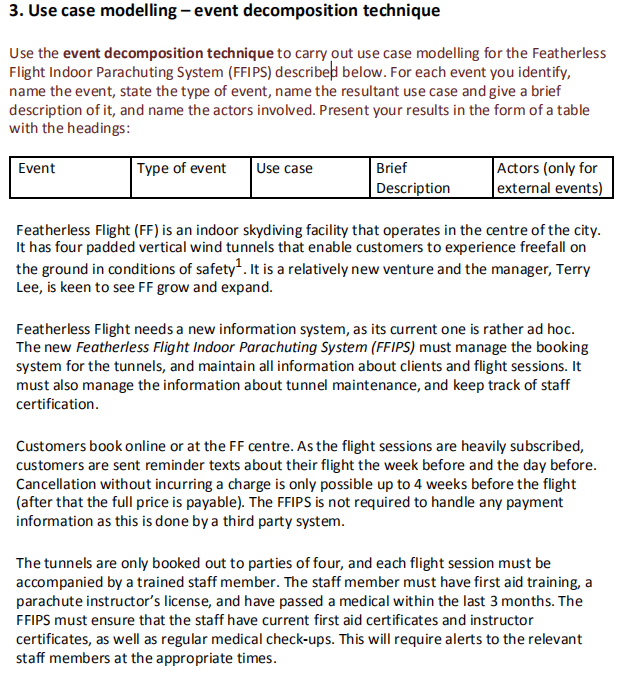
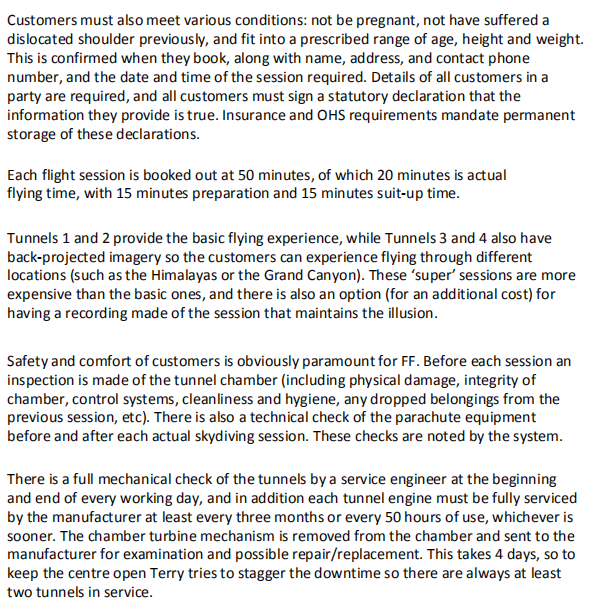
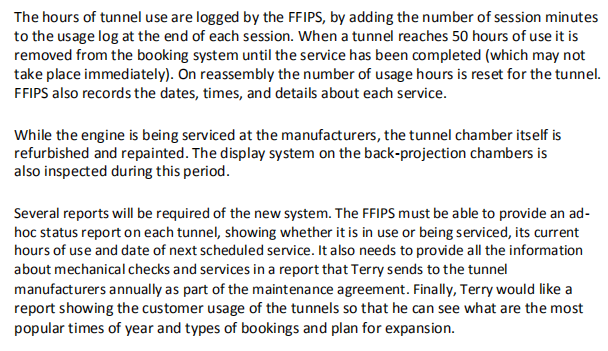
3. Use case modelling - event decomposition technique Use the event decomposition technique to carry out use case modelling for the Featherless Flight Indoor Parachuting System (FFIPS) described below. For each event you identify, name the event, state the type of event, name the resultant use case and give a brief description of it, and name the actors involved. Present your results in the form of a table with the headings: Event Type of event Use case Brief Description Actors (only for external events) Featherless Flight (FF) is an indoor skydiving facility that operates in the centre of the city. It has four padded vertical wind tunnels that enable customers to experience freefall on the ground in conditions of safety. It is a relatively new venture and the manager, Terry Lee, is keen to see FF grow and expand. Featherless Flight needs a new information system, as its current one is rather ad hoc. The new Featherless Flight Indoor Parachuting System (FFIPS) must manage the booking system for the tunnels, and maintain all information about clients and flight sessions. It must also manage the information about tunnel maintenance, and keep track of staff certification. Customers book online or at the FF centre. As the flight sessions are heavily subscribed, customers are sent reminder texts about their flight the week before and the day before. Cancellation without incurring a charge is only possible up to 4 weeks before the flight (after that the full price is payable). The FFIPS is not required to handle any payment information as this is done by a third party system. The tunnels are only booked out to parties of four, and each flight session must be accompanied by a trained staff member. The staff member must have first aid training, a parachute instructor's license, and have passed a medical within the last 3 months. The FFIPS must ensure that the staff have current first aid certificates and instructor certificates, as well as regular medical check-ups. This will require alerts to the relevant staff members at the appropriate times. Customers must also meet various conditions: not be pregnant, not have suffered a dislocated shoulder previously, and fit into a prescribed range of age, height and weight. This is confirmed when they book, along with name, address, and contact phone number, and the date and time of the session required. Details of all customers in a party are required, and all customers must sign a statutory declaration that the information they provide is true. Insurance and OHS requirements mandate permanent storage of these declarations. Each flight session is booked out at 50 minutes, of which 20 minutes is actual flying time, with 15 minutes preparation and 15 minutes suit-up time. Tunnels 1 and 2 provide the basic flying experience, while Tunnels 3 and 4 also have back-projected imagery so the customers can experience flying through different locations (such as the Himalayas or the Grand Canyon). These 'super' sessions are more expensive than the basic ones, and there is also an option (for an additional cost) for having a recording made of the session that maintains the illusion. Safety and comfort of customers is obviously paramount for FF. Before each session an inspection is made of the tunnel chamber (including physical damage, integrity of chamber, control systems, cleanliness and hygiene, any dropped belongings from the previous session, etc). There is also a technical check of the parachute equipment before and after each actual skydiving session. These checks are noted by the system. There is a full mechanical check of the tunnels by a service engineer at the beginning and end of every working day, and in addition each tunnel engine must be fully serviced by the manufacturer at least every three months or every 50 hours of use, whichever is sooner. The chamber turbine mechanism is removed from the chamber and sent to the manufacturer for examination and possible repair/replacement. This takes 4 days, so to keep the centre open Terry tries to stagger the downtime so there are always at least two tunnels in service. The hours of tunnel use are logged by the FFIPS, by adding the number of session minutes to the usage log at the end of each session. When a tunnel reaches 50 hours of use it is removed from the booking system until the service has been completed (which may not take place immediately). On reassembly the number of usage hours is reset for the tunnel. FFIPS also records the dates, times, and details about each service. While the engine is being serviced at the manufacturers, the tunnel chamber itself is refurbished and repainted. The display system on the back-projection chambers is also inspected during this period. Several reports will be required of the new system. The FFIPS must be able to provide an ad- hoc status report on each tunnel, showing whether it is in use or being serviced, its current hours of use and date of next scheduled service. It also needs to provide all the information about mechanical checks and services in a report that Terry sends to the tunnel manufacturers annually as part of the maintenance agreement. Finally, Terry would like a report showing the customer usage of the tunnels so that he can see what are the most popular times of year and types of bookings and plan for expansion. 3. Use case modelling - event decomposition technique Use the event decomposition technique to carry out use case modelling for the Featherless Flight Indoor Parachuting System (FFIPS) described below. For each event you identify, name the event, state the type of event, name the resultant use case and give a brief description of it, and name the actors involved. Present your results in the form of a table with the headings: Event Type of event Use case Brief Description Actors (only for external events) Featherless Flight (FF) is an indoor skydiving facility that operates in the centre of the city. It has four padded vertical wind tunnels that enable customers to experience freefall on the ground in conditions of safety. It is a relatively new venture and the manager, Terry Lee, is keen to see FF grow and expand. Featherless Flight needs a new information system, as its current one is rather ad hoc. The new Featherless Flight Indoor Parachuting System (FFIPS) must manage the booking system for the tunnels, and maintain all information about clients and flight sessions. It must also manage the information about tunnel maintenance, and keep track of staff certification. Customers book online or at the FF centre. As the flight sessions are heavily subscribed, customers are sent reminder texts about their flight the week before and the day before. Cancellation without incurring a charge is only possible up to 4 weeks before the flight (after that the full price is payable). The FFIPS is not required to handle any payment information as this is done by a third party system. The tunnels are only booked out to parties of four, and each flight session must be accompanied by a trained staff member. The staff member must have first aid training, a parachute instructor's license, and have passed a medical within the last 3 months. The FFIPS must ensure that the staff have current first aid certificates and instructor certificates, as well as regular medical check-ups. This will require alerts to the relevant staff members at the appropriate times. Customers must also meet various conditions: not be pregnant, not have suffered a dislocated shoulder previously, and fit into a prescribed range of age, height and weight. This is confirmed when they book, along with name, address, and contact phone number, and the date and time of the session required. Details of all customers in a party are required, and all customers must sign a statutory declaration that the information they provide is true. Insurance and OHS requirements mandate permanent storage of these declarations. Each flight session is booked out at 50 minutes, of which 20 minutes is actual flying time, with 15 minutes preparation and 15 minutes suit-up time. Tunnels 1 and 2 provide the basic flying experience, while Tunnels 3 and 4 also have back-projected imagery so the customers can experience flying through different locations (such as the Himalayas or the Grand Canyon). These 'super' sessions are more expensive than the basic ones, and there is also an option (for an additional cost) for having a recording made of the session that maintains the illusion. Safety and comfort of customers is obviously paramount for FF. Before each session an inspection is made of the tunnel chamber (including physical damage, integrity of chamber, control systems, cleanliness and hygiene, any dropped belongings from the previous session, etc). There is also a technical check of the parachute equipment before and after each actual skydiving session. These checks are noted by the system. There is a full mechanical check of the tunnels by a service engineer at the beginning and end of every working day, and in addition each tunnel engine must be fully serviced by the manufacturer at least every three months or every 50 hours of use, whichever is sooner. The chamber turbine mechanism is removed from the chamber and sent to the manufacturer for examination and possible repair/replacement. This takes 4 days, so to keep the centre open Terry tries to stagger the downtime so there are always at least two tunnels in service. The hours of tunnel use are logged by the FFIPS, by adding the number of session minutes to the usage log at the end of each session. When a tunnel reaches 50 hours of use it is removed from the booking system until the service has been completed (which may not take place immediately). On reassembly the number of usage hours is reset for the tunnel. FFIPS also records the dates, times, and details about each service. While the engine is being serviced at the manufacturers, the tunnel chamber itself is refurbished and repainted. The display system on the back-projection chambers is also inspected during this period. Several reports will be required of the new system. The FFIPS must be able to provide an ad- hoc status report on each tunnel, showing whether it is in use or being serviced, its current hours of use and date of next scheduled service. It also needs to provide all the information about mechanical checks and services in a report that Terry sends to the tunnel manufacturers annually as part of the maintenance agreement. Finally, Terry would like a report showing the customer usage of the tunnels so that he can see what are the most popular times of year and types of bookings and plan for expansion
Step by Step Solution
There are 3 Steps involved in it

Get step-by-step solutions from verified subject matter experts
 Study Help