







Question: 3. Use the data file birthweight_smoking.csv for this question. A detailed description of the data set is given in birthweight_smoking_description.pdf. In this exercise, you will
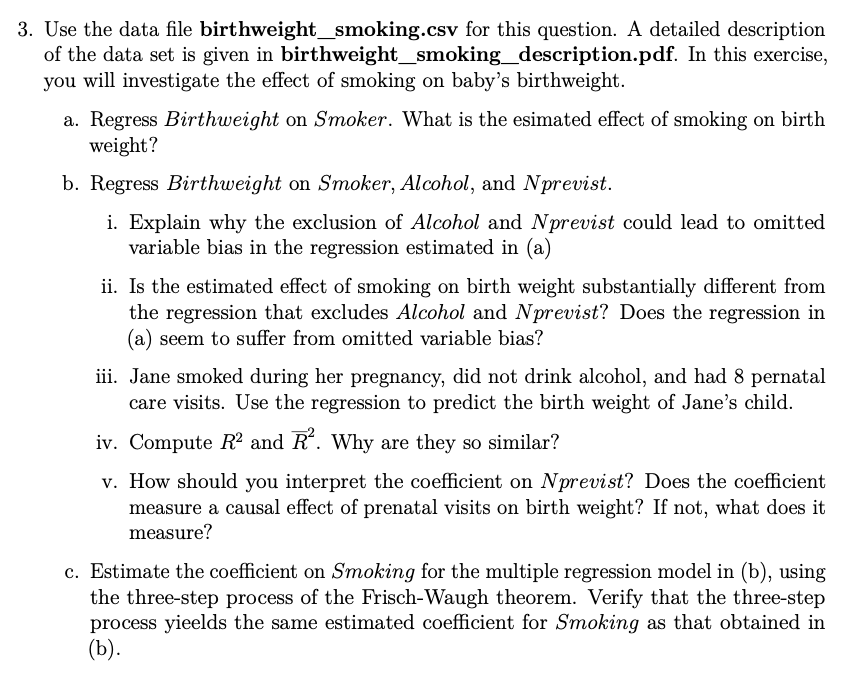
3. Use the data file birthweight_smoking.csv for this question. A detailed description of the data set is given in birthweight_smoking_description.pdf. In this exercise, you will investigate the effect of smoking on baby's birthweight. a. Regress Birthweight on Smoker. What is the esimated effect of smoking on birth weight? b. Regress Birthweight on Smoker, Alcohol, and Nprevist. i. Explain why the exclusion of Alcohol and Nprevist could lead to omitted variable bias in the regression estimated in (a) ii. Is the estimated effect of smoking on birth weight substantially different from the regression that excludes Alcohol and Nprevist? Does the regression in (a) seem to suffer from omitted variable bias? iii. Jane smoked during her pregnancy, did not drink alcohol, and had 8 pernatal care visits. Use the regression to predict the birth weight of Jane's child. iv. Compute R2 and R. Why are they so similar? v. How should you interpret the coefficient on Nprevist? Does the coefficient measure a causal effect of prenatal visits on birth weight? If not, what does it measure? c. Estimate the coefficient on Smoking for the multiple regression model in (b), using the three-step process of the Frisch-Waugh theorem. Verify that the three-step process yieelds the same estimated coefficient for Smoking as that obtained in (b)
Step by Step Solution
There are 3 Steps involved in it

Get step-by-step solutions from verified subject matter experts
 Study Help