







Question: 3. Using the k-nearest-neighbors classification function kknn contained in the R kknn package, suggest a good value of k, and show how well it
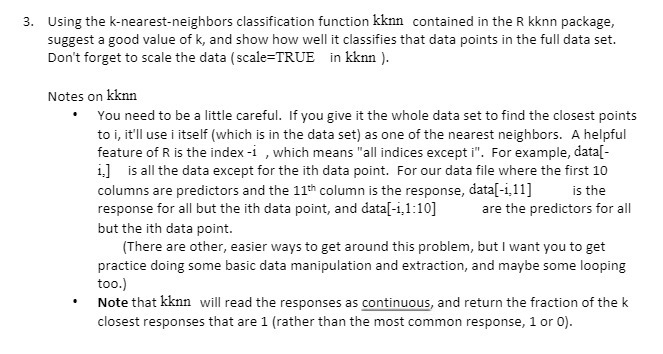
3. Using the k-nearest-neighbors classification function kknn contained in the R kknn package, suggest a good value of k, and show how well it classifies that data points in the full data set. Don't forget to scale the data (scale=TRUE in kknn). Notes on kknn You need to be a little careful. If you give it the whole data set to find the closest points to i, it'll use i itself (which is in the data set) as one of the nearest neighbors. A helpful feature of R is the index-i, which means "all indices except i". For example, data[- ,w i.] is all the data except for the ith data point. For our data file where the first 10 columns are predictors and the 11th column is the response, data[-i.11] is the response for all but the ith data point, and data[-1.1:10] are the predictors for all but the ith data point. (There are other, easier ways to get around this problem, but I want you to get practice doing some basic data manipulation and extraction, and maybe some looping too.) Note that kknn will read the responses as continuous, and return the fraction of the k closest responses that are 1 (rather than the most common response, 1 or 0).
Step by Step Solution
There are 3 Steps involved in it

Get step-by-step solutions from verified subject matter experts
 Study Help