







Question: 3. Using the special form let, we can declare some substitutions for use within an expression. To illustrate this, we use an equation relating atmospheric
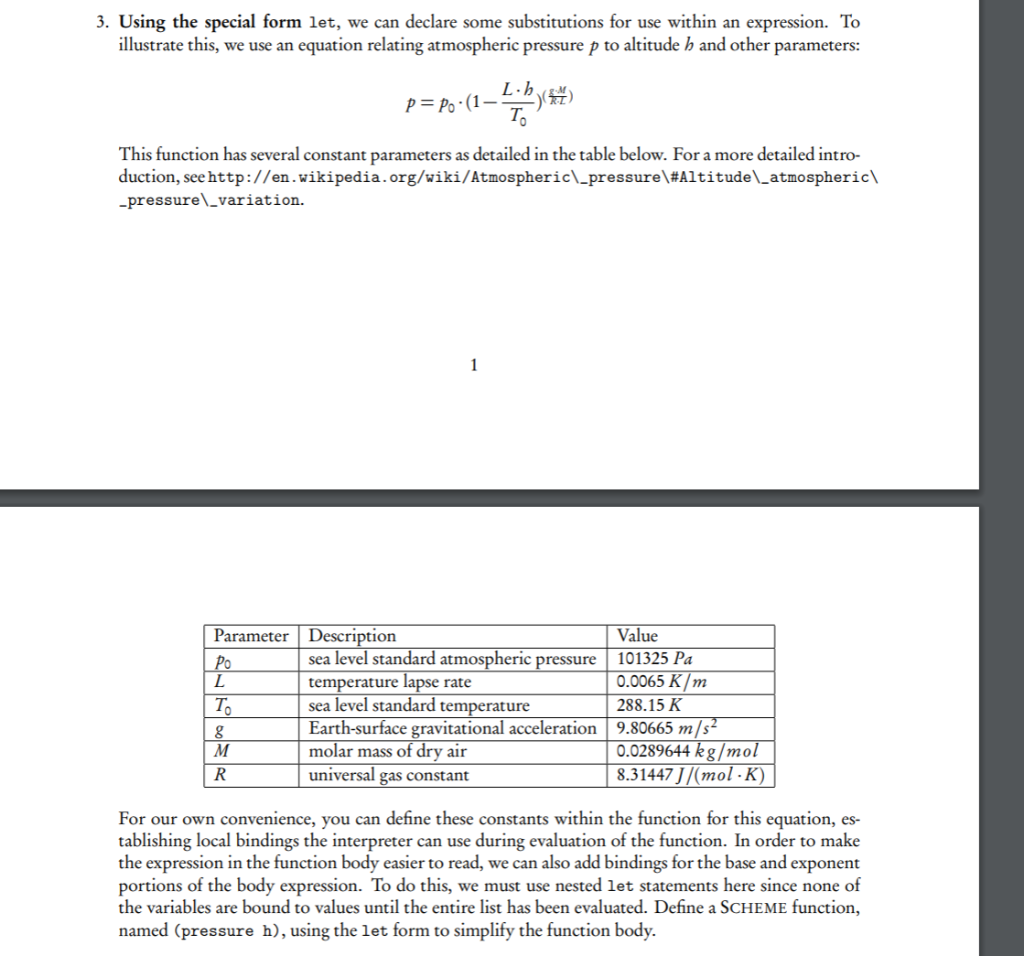
3. Using the special form let, we can declare some substitutions for use within an expression. To illustrate this, we use an equation relating atmospheric pressure p to altitude h and other parameters: L. (4) p=po-(1- T. This function has several constant parameters as detailed in the table below. For a more detailed intro- duction, see http://en.wikipedia.org/wiki/Atmospheric\_pressure #Altitude\_atmospheric -pressure\_variation. Parameter | Po Description sea level standard atmospheric pressure temperature lapse rate sea level standard temperature Earth-surface gravitational acceleration molar mass of dry air universal gas constant Value 101325 Pa 0.0065 Km 288.15 K 9.80665 m/s2 0.0289644 kg/mol 8.31447J/mol .K) 10 For our own convenience, you can define these constants within the function for this equation, es- tablishing local bindings the interpreter can use during evaluation of the function. In order to make the expression in the function body easier to read, we can also add bindings for the base and exponent portions of the body expression. To do this, we must use nested let statements here since none of the variables are bound to values until the entire list has been evaluated. Define a SCHEME function, named (pressure h), using the let form to simplify the function body. 3. Using the special form let, we can declare some substitutions for use within an expression. To illustrate this, we use an equation relating atmospheric pressure p to altitude h and other parameters: L. (4) p=po-(1- T. This function has several constant parameters as detailed in the table below. For a more detailed intro- duction, see http://en.wikipedia.org/wiki/Atmospheric\_pressure #Altitude\_atmospheric -pressure\_variation. Parameter | Po Description sea level standard atmospheric pressure temperature lapse rate sea level standard temperature Earth-surface gravitational acceleration molar mass of dry air universal gas constant Value 101325 Pa 0.0065 Km 288.15 K 9.80665 m/s2 0.0289644 kg/mol 8.31447J/mol .K) 10 For our own convenience, you can define these constants within the function for this equation, es- tablishing local bindings the interpreter can use during evaluation of the function. In order to make the expression in the function body easier to read, we can also add bindings for the base and exponent portions of the body expression. To do this, we must use nested let statements here since none of the variables are bound to values until the entire list has been evaluated. Define a SCHEME function, named (pressure h), using the let form to simplify the function body
Step by Step Solution
There are 3 Steps involved in it

Get step-by-step solutions from verified subject matter experts
 Study Help