





Question: (3) We can use a homogeneous linear system to model how a xed amount of resources change between dierent states or locations. For example, we
(3) We can use a homogeneous linear system to(3) We can use a homogeneous linear system to
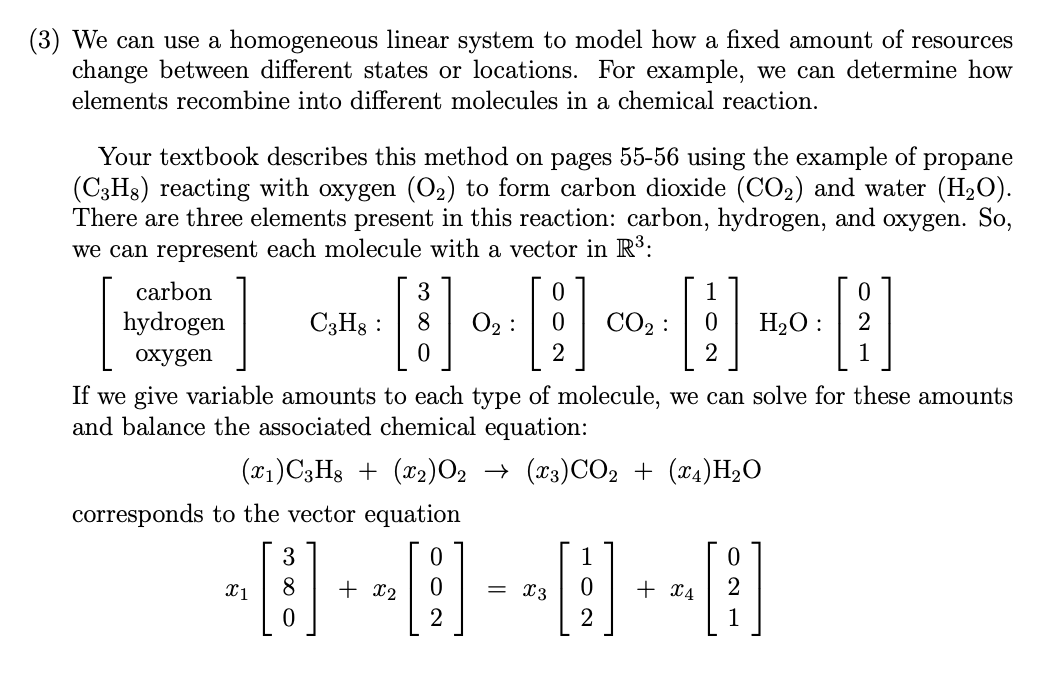
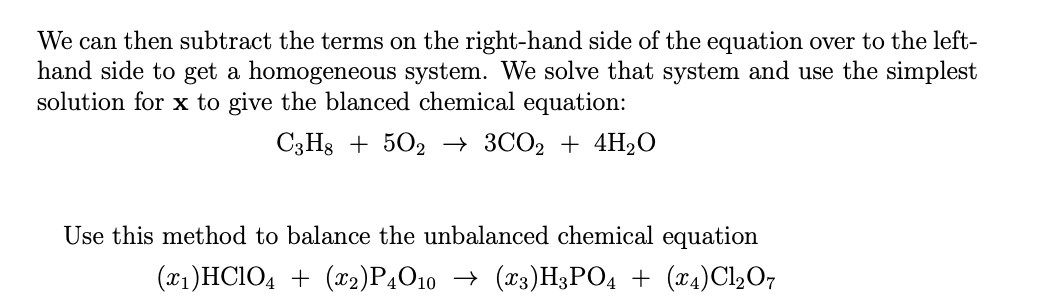
(3) We can use a homogeneous linear system to model how a xed amount of resources change between dierent states or locations. For example, we can determine how elements recombine into different molecules in a chemical reaction. Your textbook describes this method on pages 55-56 using the example of propane (03118) reacting with oxygen (02) to form carbon dioxide (C(32) and water (H20). There are three elements present in this reaction: carbon, hydrogen, and oxygen. So, we can represent each molecule with a vector in R3: carbon 3 0 1 0 hydrogen CgHg : 8 02 : 0 002 : 0 H20 : 2 oxygen 0 2 2 1 If we give variable amounts to each type of molecule, we can solve for these amounts and balance the associated chemical equation: (53003113 + (332)02 ) (153)002 'i (534)1'120 corresponds to the vector equation 3 0 1 0 $1 8 + $2 0 $3 0 + $4 2 0 2 2 1 We can then subtract the terms on the right-hand side of the equation over to the left- hand side to get a homogeneous system. We solve that system and use the simplest solution for x to give the blanced chemical equation: CgHg + 502 > 3002 + 41120 Use this method to balance the unbalanced chemical equation ($1)HCIO4 + ($2)P4010 ) (333)1'131304 + (324)01207

Step by Step Solution

There are 3 Steps involved in it

1 Expert Approved Answer
Step: 1 Unlock blur-text-image
Question Has Been Solved by an Expert!

Get step-by-step solutions from verified subject matter experts

Step: 2 Unlock
Step: 3 Unlock

Students Have Also Explored These Related Mathematics Questions!