







Question: 3 Year 2 4 Quantitative Problem 1: Assume today is December 31, 2016. Barrington Industries expects that its 2017 after-tax operating income (EBIT(1 - 1)]
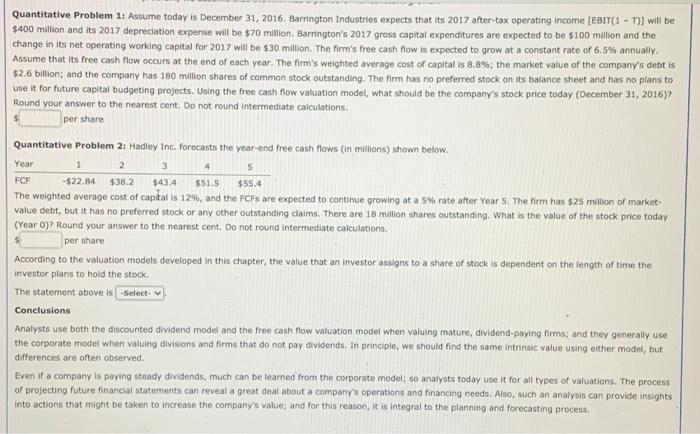
Year 2 4 Quantitative Problem 1: Assume today is December 31, 2016. Barrington Industries expects that its 2017 after-tax operating income (EBIT(1 - 1)] will be $400 million and its 2017 depreciation expense will be $70 million, Barrington's 2017 gross capital expenditures are expected to be $100 million and the change in its net operating working capital for 2017 will be $30 million. The firm's free cash flow is expected to grow at a constant rate of 6.5% annually. Assume that its free cash low occurs at the end of each year. The firm's weighted average cost of capital is 8.8%; the market value of the company's debt is $2.6 billion; and the company has 180 million shares of common stock outstanding. The firm has no preferred stock on its balance sheet and has no plans to use it for future capital budgeting projects. Using the free cash flow valuation model, what should be the company's stock price today (December 31, 2016) Round your answer to the nearest cent. Do not round intermediate calculations per share Quantitative Problem 2: Hadley Inc. forecasts the year-end free cash flows (in millions) shown below. 1 3 5 FCF - $22.84 $38.2 $43.4 $51.5 $55.4 The weighted average cost of capital is 12%, and the FCFs are expected to continue growing at a 5% rate after years. The firm has $25 million of market value debt, but it has no proferred stock or any other outstanding claims. There are 18 million shares outstanding. What is the value of the stock price today (Year 07 Round your answer to the nearest cent. Do not round intermediate calculations. per share According to the valuation models developed in this chapter, the value that an investor assigns to a share of stock is dependent on the length of time the investor plans to hold the stock. The statement above is Select Conclusions Analysts use both the discounted dividend model and the free cash flow valuation model when valuing mature, dividend paying firms; and they generally use the corporate model when valuing divisions and firms that do not pay dividends. In principle, we should find the same intrinsic value using either model, but differences are often observed. Even if a company is paying steady dividends, much can be learned from the corporate model: so analysts today use it for all types of valuations. The process of projecting future financial statements can reveal a great deal about a company's operations and financing needs. Also, such an analysis can provide insights into actions that might be taken to increase the company's value and for this reason, it is integral to the planning and forecasting process
Step by Step Solution
There are 3 Steps involved in it

Get step-by-step solutions from verified subject matter experts
 Study Help