







Question: 3. You are given two different Bayesian network structures 1 and 2, each consisting of !5 binary random variables A, B, C, D, E. Each
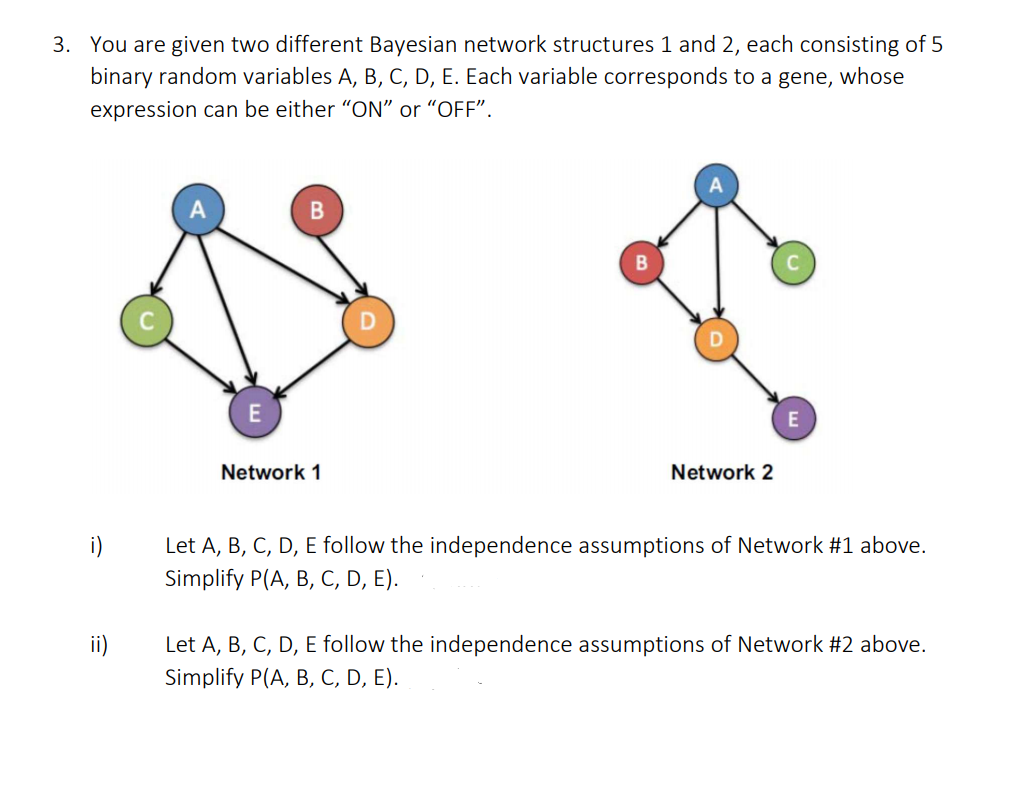
3. You are given two different Bayesian network structures 1 and 2, each consisting of !5 binary random variables A, B, C, D, E. Each variable corresponds to a gene, whose expression can be either "ON" or "OFF" Network1 Network 2 Let A, B, C, D, E follow the independence assumptions of Network #1 above. Simplify P(A, B, C, D, E). Let A, B, C, D, E follow the independence assumptions of Network #2 above. Simplify P(A, B, C, D, E) 3. You are given two different Bayesian network structures 1 and 2, each consisting of !5 binary random variables A, B, C, D, E. Each variable corresponds to a gene, whose expression can be either "ON" or "OFF" Network1 Network 2 Let A, B, C, D, E follow the independence assumptions of Network #1 above. Simplify P(A, B, C, D, E). Let A, B, C, D, E follow the independence assumptions of Network #2 above. Simplify P(A, B, C, D, E)
Step by Step Solution
There are 3 Steps involved in it

Get step-by-step solutions from verified subject matter experts
 Study Help