







Question: (30 pts total) a) 1. (25 pts) Develop a 10-bit 2's complement adder/subtractor combinational circuit that uses 4-bit full adder chips and a control bit
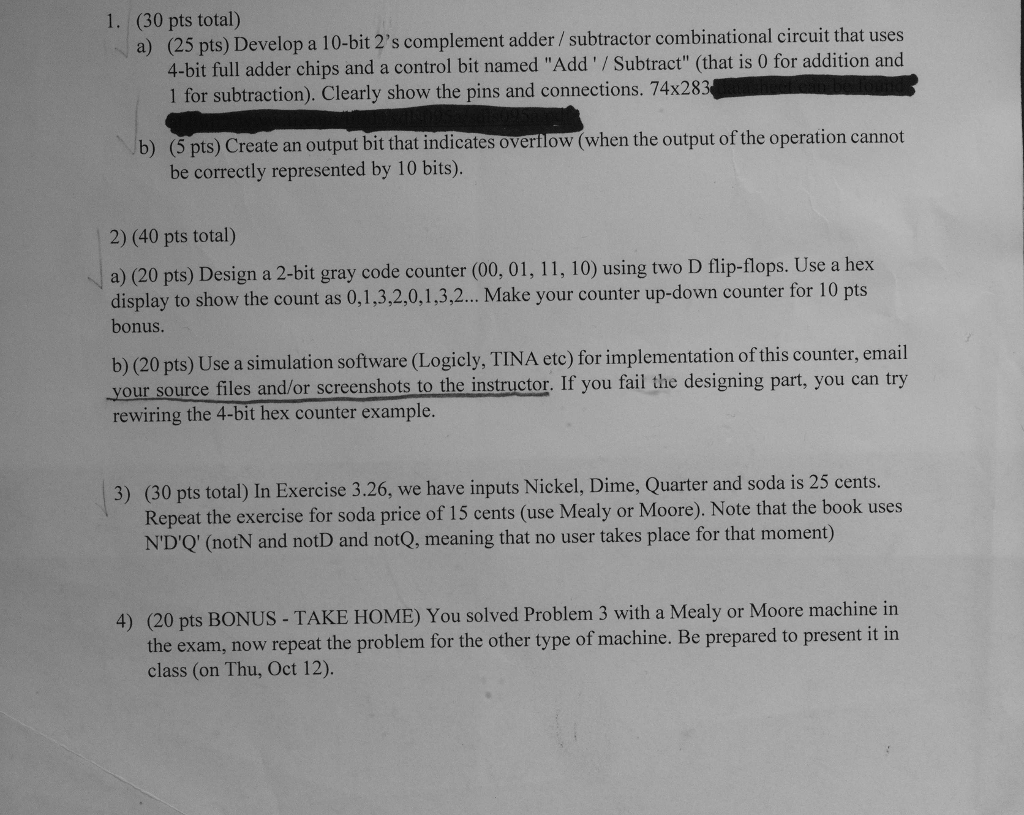
(30 pts total) a) 1. (25 pts) Develop a 10-bit 2's complement adder/subtractor combinational circuit that uses 4-bit full adder chips and a control bit named "Add'/ Subtract" (that is 0 for addition and 1 for subtraction). Clearly show the pins and connections. 74x283 b) (3 pts) Create an output bit that indicates overhlow (when the output of the operation cannot be correctly represented by 10 bits). 2) (40 pts total) a) (20 pts) Design a 2-bit gray code counter (00, 01, 11, 10) using two D flip-flops. Use a hex display to show the count as 0,1,3,2,0,1,3,2... Make your counter up-down counter for 10 pts j bonus. b) (20 pts) Use a simulation software (Logicly, TINA etc) for implementation of this counter, email your source files and/or screenshots to the instructor. If you fail the designing part, you can try rewiring the 4-bit hex counter example 3) (30 pts total) In Exercise 3.26, we have inputs Nickel, Dime, Quarter and soda is 25 cents. Repeat the exercise for soda price of 15 cents (use Mealy or Moore). Note that the book uses ND'Q (notN and notD and notQ, meaning that no user takes place for that moment) 4) (20 pts BONUS - TAKE HOME) You solved Problem 3 with a Mealy or Moore machine in the exam, now repeat the problem for the other type of machine. Be prepared to present it in class (on Thu, Oct 12). (30 pts total) a) 1. (25 pts) Develop a 10-bit 2's complement adder/subtractor combinational circuit that uses 4-bit full adder chips and a control bit named "Add'/ Subtract" (that is 0 for addition and 1 for subtraction). Clearly show the pins and connections. 74x283 b) (3 pts) Create an output bit that indicates overhlow (when the output of the operation cannot be correctly represented by 10 bits). 2) (40 pts total) a) (20 pts) Design a 2-bit gray code counter (00, 01, 11, 10) using two D flip-flops. Use a hex display to show the count as 0,1,3,2,0,1,3,2... Make your counter up-down counter for 10 pts j bonus. b) (20 pts) Use a simulation software (Logicly, TINA etc) for implementation of this counter, email your source files and/or screenshots to the instructor. If you fail the designing part, you can try rewiring the 4-bit hex counter example 3) (30 pts total) In Exercise 3.26, we have inputs Nickel, Dime, Quarter and soda is 25 cents. Repeat the exercise for soda price of 15 cents (use Mealy or Moore). Note that the book uses ND'Q (notN and notD and notQ, meaning that no user takes place for that moment) 4) (20 pts BONUS - TAKE HOME) You solved Problem 3 with a Mealy or Moore machine in the exam, now repeat the problem for the other type of machine. Be prepared to present it in class (on Thu, Oct 12)
Step by Step Solution
There are 3 Steps involved in it

Get step-by-step solutions from verified subject matter experts
 Study Help