







Question: = 30%, r = 8%, T = 1, and 8 = 0. Let u = 1.3, d = 0.8, 10.6 Let S = $100, K
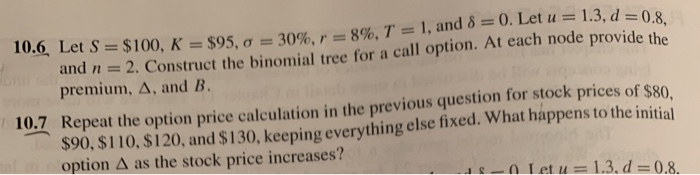
= 30%, r = 8%, T = 1, and 8 = 0. Let u = 1.3, d = 0.8, 10.6 Let S = $100, K = $95, o = and n = 2. Construct the binomial tree for a call option. At each node provide the premium, A, and B. 10.7 Repeat the option price calculation in the previous question for stock prices of $80, $90, $110, $120, and $130, keeping everything else fixed. What happens to the initial option A as the stock price increases? Let u = 1.3.d = 0.8. = 30%, r = 8%, T = 1, and 8 = 0. Let u = 1.3, d = 0.8, 10.6 Let S = $100, K = $95, o = and n = 2. Construct the binomial tree for a call option. At each node provide the premium, A, and B. 10.7 Repeat the option price calculation in the previous question for stock prices of $80, $90, $110, $120, and $130, keeping everything else fixed. What happens to the initial option A as the stock price increases? Let u = 1.3.d = 0.8
Step by Step Solution
There are 3 Steps involved in it

Get step-by-step solutions from verified subject matter experts
 Study Help