Question: (30 Read the case study below and answer the questions that follow. MARKS) Quality Metrics Enable Continuous Process Improvement Fisher Clinical Services' operational metrics include
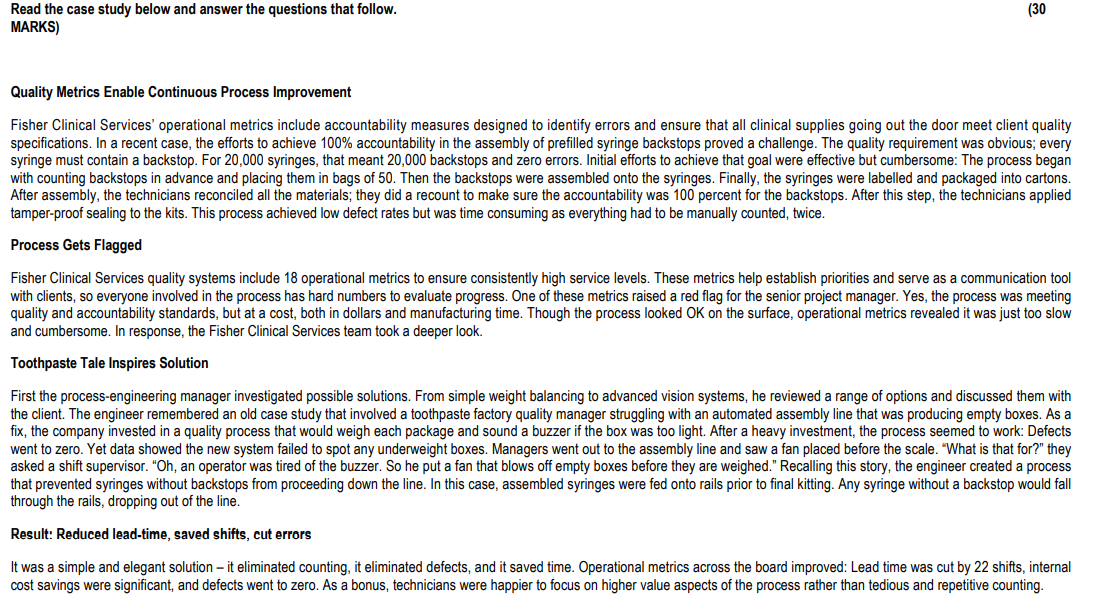
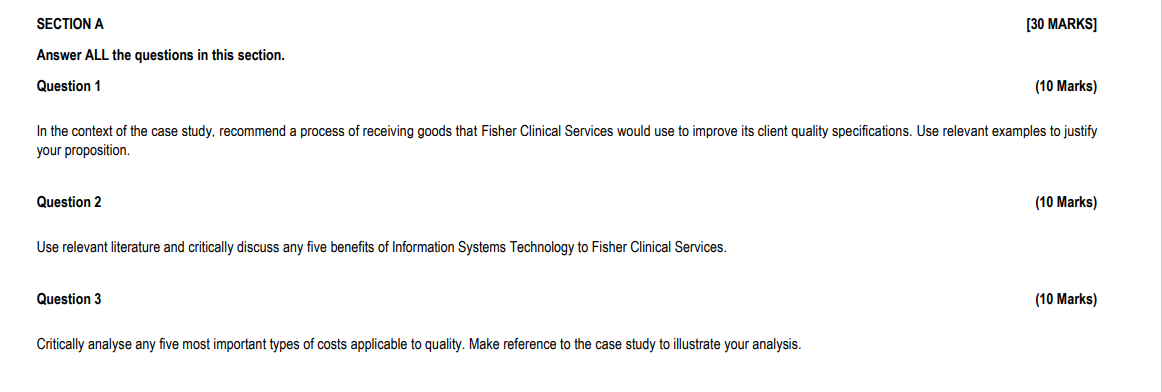
(30 Read the case study below and answer the questions that follow. MARKS) Quality Metrics Enable Continuous Process Improvement Fisher Clinical Services' operational metrics include accountability measures designed to identify errors and ensure that all clinical supplies going out the door meet client quality specifications. In a recent case, the efforts to achieve 100% accountability in the assembly of prefilled syringe backstops proved a challenge. The quality requirement was obvious; every syringe must contain a backstop. For 20,000 syringes, that meant 20,000 backstops and zero errors. Initial efforts to achieve that goal were effective but cumbersome: The process began with counting backstops in advance and placing them in bags of 50. Then the backstops were assembled onto the syringes. Finally, the syringes were labelled and packaged into cartons. After assembly, the technicians reconciled all the materials; they did a recount to make sure the accountability was 100 percent for the backstops. After this step, the technicians applied tamper-proof sealing to the kits. This process achieved low defect rates but was time consuming as everything had to be manually counted, twice. Process Gets Flagged Fisher Clinical Services quality systems include 18 operational metrics to ensure consistently high service levels. These metrics help establish priorities and serve as a communication tool with clients, so everyone involved in the process has hard numbers to evaluate progress. One of these metrics raised a red flag for the senior project manager. Yes, the process was meeting quality and accountability standards, but at a cost, both in dollars and manufacturing time. Though the process looked OK on the surface, operational metrics revealed it was just too slow and cumbersome. In response, the Fisher Clinical Services team took a deeper look. Toothpaste Tale Inspires Solution First the process-engineering manager investigated possible solutions. From simple weight balancing to advanced vision systems, he reviewed a range of options and discussed them with the client. The engineer remembered an old case study that involved a toothpaste factory quality manager struggling with an automated assembly line that was producing empty boxes. As a fix, the company invested in a quality process that would weigh each package and sound a buzzer if the box was too light. After a heavy investment, the process seemed to work: Defects went to zero. Yet data showed the new system failed to spot any underweight boxes. Managers went out to the assembly line and saw a fan placed before the scale. "What is that for?" they asked a shift supervisor. "Oh, an operator was tired of the buzzer. So he put a fan that blows off empty boxes before they are weighed." Recalling this story, the engineer created a process that prevented syringes without backstops from proceeding down the line. In this case, assembled syringes were fed onto rails prior to final kitting. Any syringe without a backstop would fall through the rails, dropping out of the line. Result: Reduced lead-time, saved shifts, cut errors It was a simple and elegant solution - it eliminated counting, it eliminated defects, and it saved time. Operational metrics across the board improved: Lead time was cut by 22 shifts, internal cost savings were significant, and defects went to zero. As a bonus, technicians were happier to focus on higher value aspects of the process rather than tedious and repetitive counting. SECTION A [30 MARKS] Answer ALL the questions in this section. Question 1 (10 Marks) In the context of the case study, recommend a process of receiving goods that Fisher Clinical Services would use to improve its client quality specifications. Use relevant examples to justify your proposition. Question 2 (10 Marks) Use relevant literature and critically discuss any five benefits of Information Systems Technology to Fisher Clinical Services. Question 3 (10 Marks) Critically analyse any five most important types of costs applicable to quality. Make reference to the case study to illustrate your analysis









 Study Help