







Question: [3.03/9.09 Points] DETAILS PREVIOUS ANSWERS DEVORESTAT9 9.E.036.S. MY NOTES ASK YOUR TEACHER PRACTICE A Consider the accompanying data on breaking load (kg/25 mm width) for
![[3.03/9.09 Points] DETAILS PREVIOUS ANSWERS DEVORESTAT9 9.E.036.S. MY NOTES ASK YOUR](https://s3.amazonaws.com/si.experts.images/answers/2024/06/667ab381779b7_377667ab38156d04.jpg)
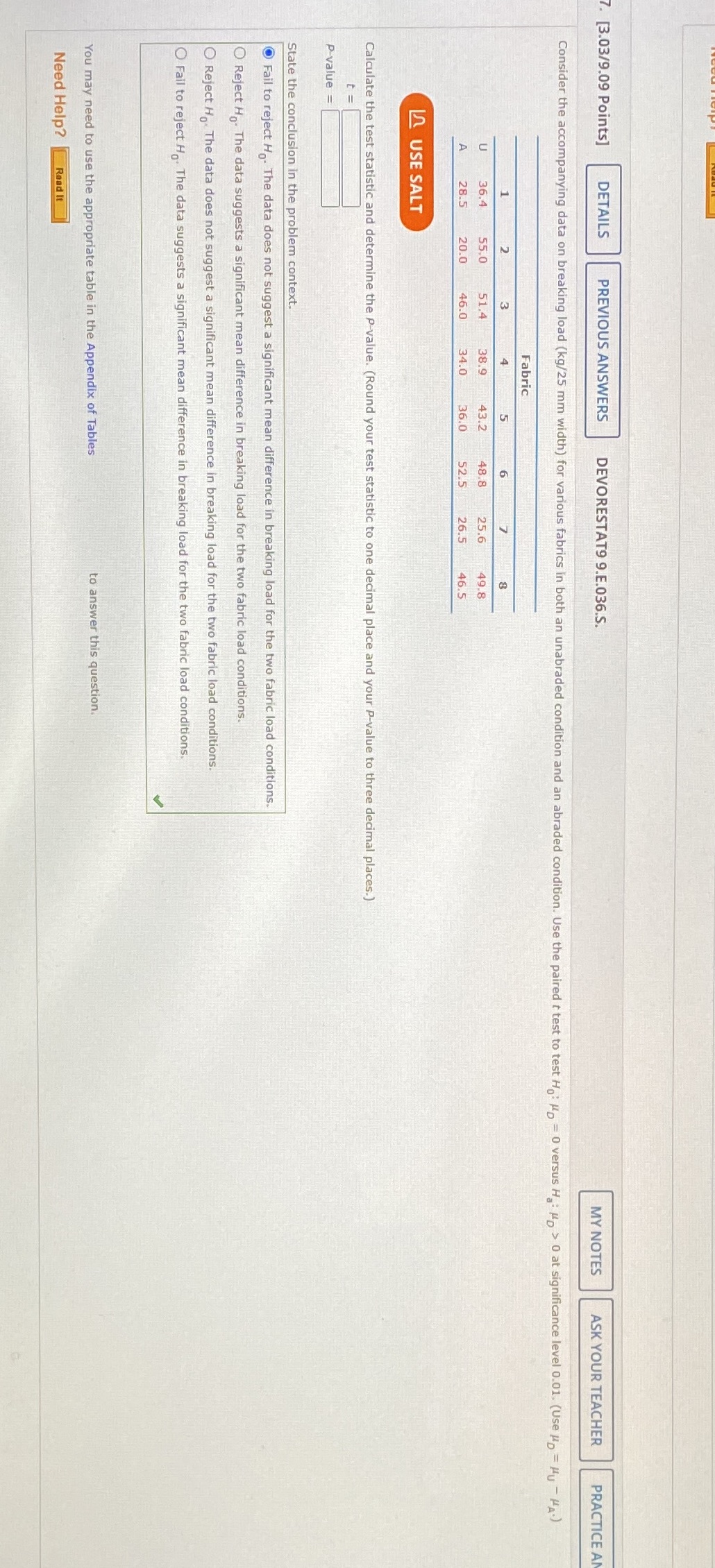
[3.03/9.09 Points] DETAILS PREVIOUS ANSWERS DEVORESTAT9 9.E.036.S. MY NOTES ASK YOUR TEACHER PRACTICE A Consider the accompanying data on breaking load (kg/25 mm width) for various fabrics in both an unabraded condition and an abraded condition. Use the paired t test to test Ho: (p = 0 versus Ha: Mp > 0 at significance level 0.01. (Use HD = Hu - HA.) Fabric 36.4 55,0 51.4 38.9 43.2 48.8 25.6 49.8 28.5 20.0 46.0 34.0 36.0 52.5 26.5 46.5 LO USE SALT Calculate the test statistic and determine the P-value. (Round your test statistic to one decimal place and your P-value to three decimal places.) P-value = State the conclusion in the problem context. Fail to reject H. The data does not suggest a significant mean difference in breaking load for the two fabric load conditions. O Reject Ho- The data suggests a significant mean difference in breaking load for the two fabric load conditions. O Reject Ho. The data does not suggest a significant mean difference in breaking load for the two fabric load conditions. Fail to reject Ho. The data suggests a significant mean difference in breaking load for the two fabric load conditions. You may need to use the appropriate table in the Appendix of Tables to answer this question. Need Help? Road It
Step by Step Solution
There are 3 Steps involved in it

Get step-by-step solutions from verified subject matter experts
 Study Help