







Question: (30pts) Write a simple sequence-number system through which three concurrent processes, P1, P2, and P3, each obtain unique integers in the range [1, 500]. Use
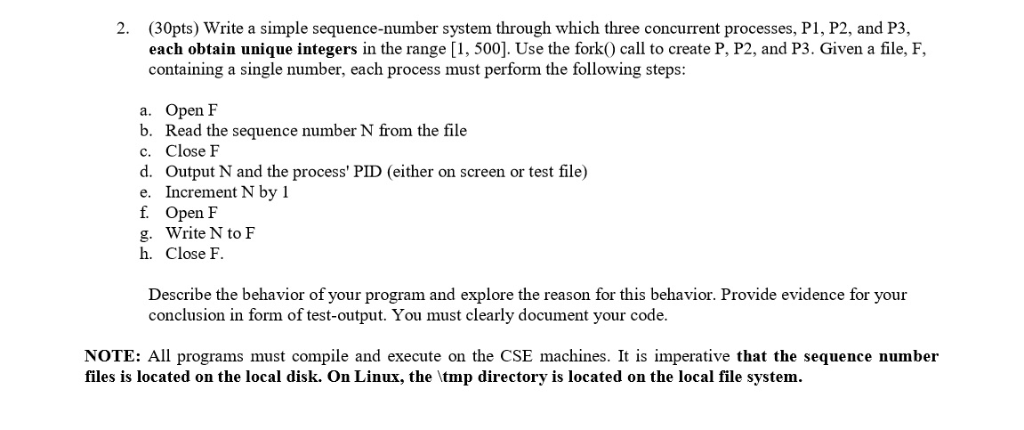
(30pts) Write a simple sequence-number system through which three concurrent processes, P1, P2, and P3, each obtain unique integers in the range [1, 500]. Use the fork0 call to create P, P2, and P3. Given a file, F, containing a single number, each process must perform the following steps: 2. a. Open F b. Read the sequence number N from the file c. Close F d. Output N and the process' PID (either on screen or test file) e. Increment N by 1 f Open F g. Write N to F h. Close F Describe the behavior of your program and explore the reason for this behavior. Provide evidence for your conclusion in form of test-output. You must clearly document your code. NOTE: All programs must compile and execute on the CSE machines. It is imperative that the sequence number files is located on the local disk. On Linux, the ltmp directory is located on the local file system (30pts) Write a simple sequence-number system through which three concurrent processes, P1, P2, and P3, each obtain unique integers in the range [1, 500]. Use the fork0 call to create P, P2, and P3. Given a file, F, containing a single number, each process must perform the following steps: 2. a. Open F b. Read the sequence number N from the file c. Close F d. Output N and the process' PID (either on screen or test file) e. Increment N by 1 f Open F g. Write N to F h. Close F Describe the behavior of your program and explore the reason for this behavior. Provide evidence for your conclusion in form of test-output. You must clearly document your code. NOTE: All programs must compile and execute on the CSE machines. It is imperative that the sequence number files is located on the local disk. On Linux, the ltmp directory is located on the local file system
Step by Step Solution
There are 3 Steps involved in it

Get step-by-step solutions from verified subject matter experts
 Study Help