







Question: 3.1. How many phase rule variables must be specified to fix the thermodynamic state of each of the following systems? (a) A sealed flask containing
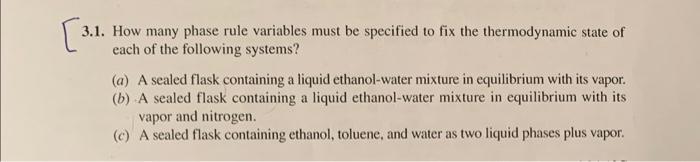



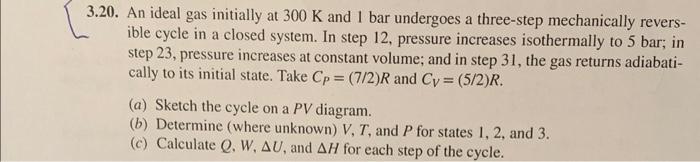
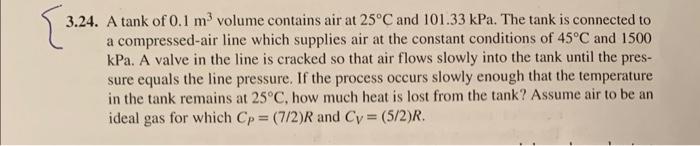
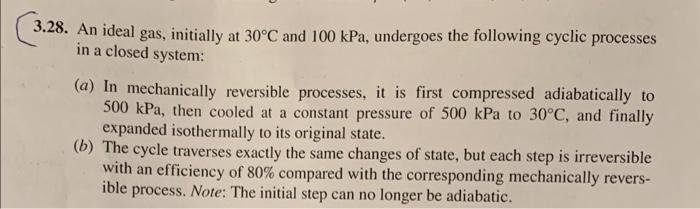
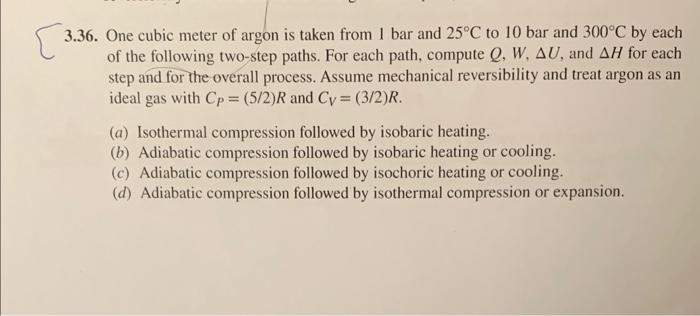
3.1. How many phase rule variables must be specified to fix the thermodynamic state of each of the following systems? (a) A sealed flask containing a liquid ethanol-water mixture in equilibrium with its vapor. (b) A sealed flask containing a liquid ethanol-water mixture in equilibrium with its vapor and nitrogen. (c) A sealed flask containing ethanol, toluene, and water as two liquid phases plus vapor. 11. Five kilograms of liquid carbon tetrachloride undergo a mechanically reversible, isobaric change of state at 1 bar during which the temperature changes from 0C to 20C. Determine Vt,W,Q,Ht, and U. The properties for liquid carbon tetrachloride at 1 bar and 0C may be assumed independent of temperature: =1.2103K1, CP=0.84kJkg1K1, and =1590kgm3. 3.14. For one of the substances in Table 3.2, compute the change in volume and work done when one kilogram of the substance is compressed from 1 bar to 100 bar at a constant temperature of 20C. 17. One mole of an ideal gas with CP=(7/2)R and CV=(5/2)R expands from P1=8 bar and T1=600K to P2=1 bar by each of the following paths: (a) Constant volume; (b) Constant temperature; (c) Adiabatically. 3.20. An ideal gas initially at 300K and 1 bar undergoes a three-step mechanically reversible cycle in a closed system. In step 12, pressure increases isothermally to 5 bar; in step 23, pressure increases at constant volume; and in step 31 , the gas returns adiabatically to its initial state. Take CP=(7/2)R and CV=(5/2)R. (a) Sketch the cycle on a PV diagram. (b) Determine (where unknown) V,T, and P for states 1,2 , and 3. (c) Calculate Q,W,U, and H for each step of the cycle. 3.24. A tank of 0.1m3 volume contains air at 25C and 101.33kPa. The tank is connected to a compressed-air line which supplies air at the constant conditions of 45C and 1500 kPa. A valve in the line is cracked so that air flows slowly into the tank until the pressure equals the line pressure. If the process occurs slowly enough that the temperature in the tank remains at 25C, how much heat is lost from the tank? Assume air to be an ideal gas for which CP=(7/2)R and CV=(5/2)R. 3.28. An ideal gas, initially at 30C and 100kPa, undergoes the following cyclic processes in a closed system: (a) In mechanically reversible processes, it is first compressed adiabatically to 500kPa, then cooled at a constant pressure of 500kPa to 30C, and finally expanded isothermally to its original state. (b) The cycle traverses exactly the same changes of state, but each step is irreversible with an efficiency of 80% compared with the corresponding mechanically reversible process. Note: The initial step can no longer be adiabatic. 3.36. One cubic meter of argon is taken from 1 bar and 25C to 10 bar and 300C by each of the following two-step paths. For each path, compute Q,W,U, and H for each step and for the overall process. Assume mechanical reversibility and treat argon as an ideal gas with CP=(5/2)R and CV=(3/2)R. (a) Isothermal compression followed by isobaric heating. (b) Adiabatic compression followed by isobaric heating or cooling. (c) Adiabatic compression followed by isochoric heating or cooling. (d) Adiabatic compression followed by isothermal compression or expansion
Step by Step Solution
There are 3 Steps involved in it

Get step-by-step solutions from verified subject matter experts
 Study Help