







Question: 3.2 Cascading Two Systems More complicated systems are often made up from simple building blocks. In the system of Fig. 3 two FIR filters are
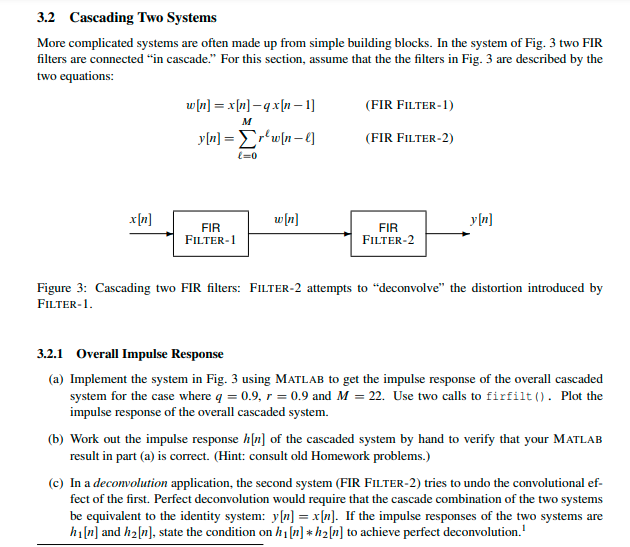
3.2 Cascading Two Systems More complicated systems are often made up from simple building blocks. In the system of Fig. 3 two FIR filters are connected"in cascade." For this section, assume that the the filters in Fig. 3 are described by the two equations: w[n] = x[n] qx [n-1) (FIR FILTER-1) y[n] = r'w[n- ] (FIR FILTER-2) M {=0 w [1] y[n] FIR FILTER-1 FIR FILTER-2 Figure 3: Cascading two FIR filters: FILTER-2 attempts to "deconvolve" the distortion introduced by FILTER-1. 3.2.1 Overall Impulse Response (a) Implement the system in Fig. 3 using MATLAB to get the impulse response of the overall cascaded system for the case where q = 0.9, r = 0.9 and M = 22. Use two calls to firfilt(). Plot the impulse response of the overall cascaded system. (6) Work out the impulse response h[n] of the cascaded system by hand to verify that your MATLAB result in part (a) is correct. (Hint: consult old Homework problems.) (c) In a deconvolution application, the second system (FIR FILTER-2) tries to undo the convolutional ef- fect of the first. Perfect deconvolution would require that the cascade combination of the two systems be equivalent to the identity system: y[n] = x[n]. If the impulse responses of the two systems are hi [n] and ha[n), state the condition on h1 [n] *h2 [n] to achieve perfect deconvolution
Step by Step Solution
There are 3 Steps involved in it

Get step-by-step solutions from verified subject matter experts
 Study Help