







Question: 32. Classify the random variables below according to whether they are discrete or continuous. I. The length of time an employee is late for work.
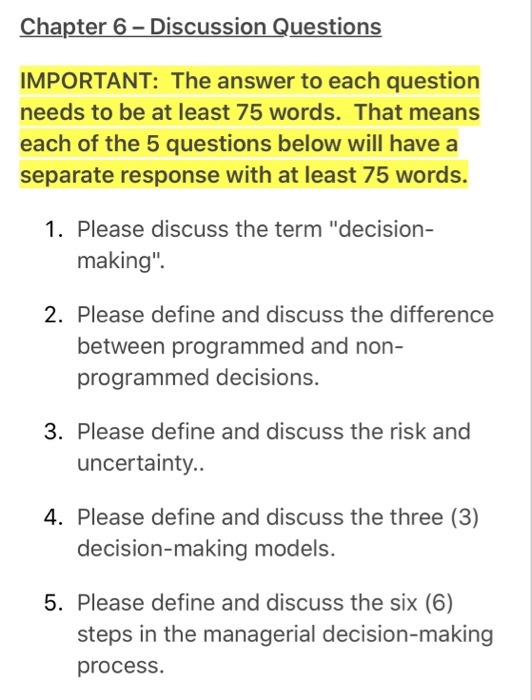
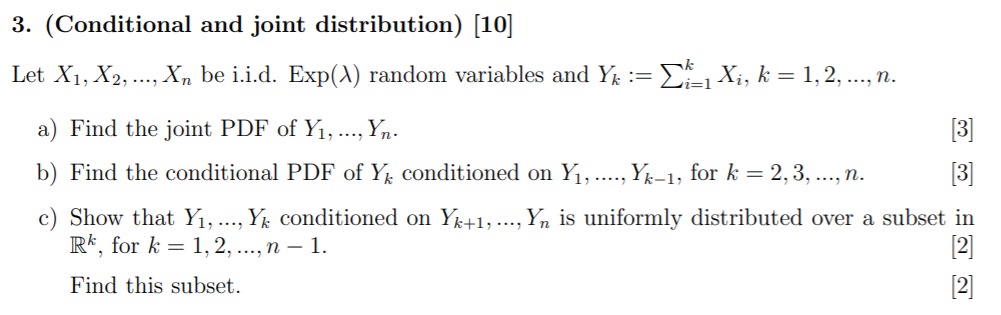
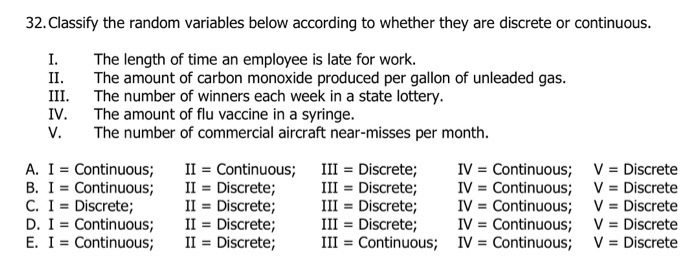
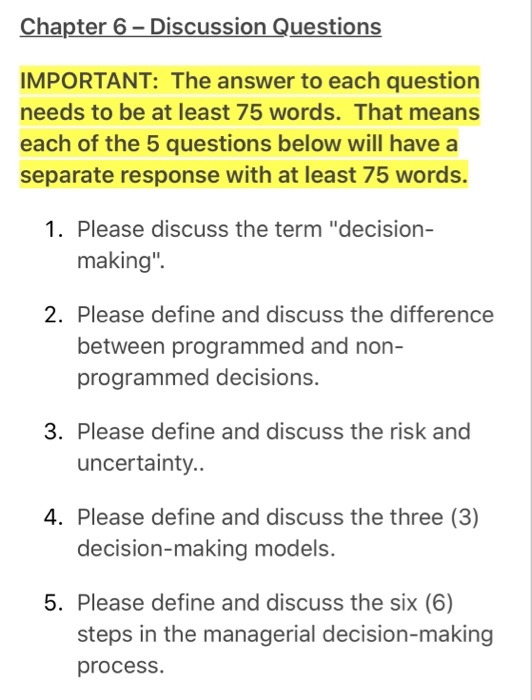
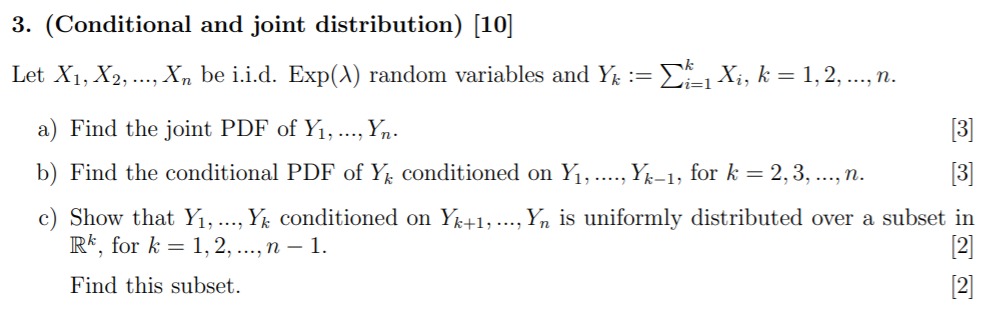
32. Classify the random variables below according to whether they are discrete or continuous. I. The length of time an employee is late for work. II. The amount of carbon monoxide produced per gallon of unleaded gas. III. The number of winners each week in a state lottery. IV. The amount of flu vaccine in a syringe. V. The number of commercial aircraft near-misses per month. A. I = Continuous; II = Continuous; III = Discrete; IV = Continuous; V = Discrete B. I = Continuous; II = Discrete; III = Discrete; IV = Continuous; V = Discrete C. I = Discrete; II = Discrete; III = Discrete; IV = Continuous; V = Discrete D. I = Continuous; II = Discrete; III = Discrete; IV = Continuous; V = Discrete E. I = Continuous; II = Discrete; III = Continuous; IV = Continuous; V = DiscreteChapter 6 - Discussion Questions IMPORTANT: The answer to each question needs to be at least 75 words. That means each of the 5 questions below will have a separate response with at least 75 words. 1. Please discuss the term "decision- making". 2. Please define and discuss the difference between programmed and non- programmed decisions. 3. Please define and discuss the risk and uncertainty.. 4. Please define and discuss the three (3) decision-making models. 5. Please define and discuss the six (6) steps in the managerial decision-making process.3. (Conditional and joint distribution) [10] Let X1, X2, ..., Xn be i.i.d. Exp()) random variables and Yk := _ Xi, k = 1, 2, ..., n. a) Find the joint PDF of Y1, ..., Yn. (3] b) Find the conditional PDF of Yk conditioned on Y1, ...., Yk-1, for k = 2, 3, ..., n. [3] c) Show that Y1, ..., YA conditioned on Yk+1, ..., Yn is uniformly distributed over a subset in Rk, for k = 1, 2, ..., n - 1. [2] Find this subset. [2]
Step by Step Solution
There are 3 Steps involved in it

Get step-by-step solutions from verified subject matter experts
 Study Help