







Question: 33. A neutral atom will become a cation if it A. gains electrons. B. gains protons. C. loses electrons. D. loses protons. E. gains


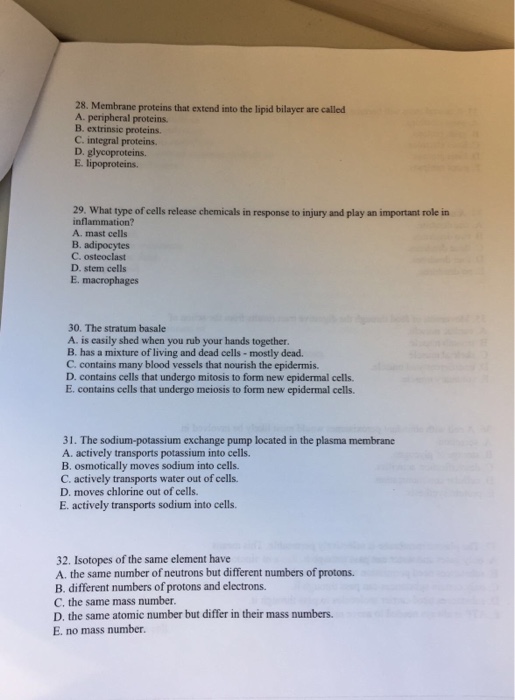
33. A neutral atom will become a cation if it A. gains electrons. B. gains protons. C. loses electrons. D. loses protons. E. gains neutrons. 34. A unipolar neuron is characterized by the presence of A. one dendrite. B. two dendrites. C. three dendrites. D. four dendrites. E. no dendrites. 35. Movement of food through the digestive tract results from the action of A. cardiac muscle. B. smooth muscle. C. skeletal muscle. D. undifferentiated muscle. E. voluntary muscle. 36. A cell with abundant peroxisomes would most likely be involved in A. secretion. B. storage of glycogen. C. detoxification activities. D. cellular communication. E. protein synthesis. 37. The plasma membrane is selectively permeable. This means A. only gases and water can pass through it. B. substances need permission to pass through it. C. only certain substances can pass through it. D. substances need carrier molecules to pass through it. E. ATP is always needed to move molecules across the plasma membrane. 47. The pH value A. increases with acidity. B. is measured on a scale from 0 to 10. C. is determined by the concentration of hydrogen ions. D. reflects the sodium content of body fluids. E. decreases with alkalinity. 48. Which of the following is NOT a function of connective tissue? A. transport B. support C. storage D. contraction E. insulation 49. The minimum amount of energy that reactants must have to start a chemical reaction is called A. kinetic energy. B. mechanical energy. C. activation energy. D. electromagnetic energy. E. potential energy. 50. In the process of diffusion, net movement of substances is always from a region A. outside the cell to a region inside the cell. B. inside the cell to a region outside the cell. C. of lower concentration to a region of higher concentration. D. of higher concentration to a region of lower concentration. E. None of these choices is correct. 43. Organize the following structural levels of the human body from simplest to most complex. (1) cell (2) tissue (3) chemical (4) organ system (5) organ A. 1, 2, 3, 4, 5 B. 2, 3, 1, 4, 5 C. 3, 1, 2, 5, 4 D. 4, 2, 3, 1, 5 E. 3, 1, 2, 4, 5 44. Which of the following statements concerning the epidermis is true? A. The dermis is superficial to the epidermis. B. The epidermis contains numerous blood vessels. C. The most numerous cells in the epidermis are the melanocytes. D. The epidermis is nourished by blood vessels located in the dermis. E. The epidermis is very permeable to water-soluble molecules. 45. An atom has an atomic number of 19 and a mass number of 39. This atom will have A. 19 neutrons. B. 20 neutrons. C. 39 neutrons. D. 58 neutrons. E. 20 electrons. 46. The presence of water in our bodies allows us to A. cool the body with sweat. B. maintain a fairly constant body temperature. C. provide an environment for chemical reactions. D. keep tissues moist and reduce friction. E. All of these choices are correct. 28. Membrane proteins that extend into the lipid bilayer are called A. peripheral proteins. B. extrinsic proteins. C. integral proteins. D. glycoproteins. E. lipoproteins. 29. What type of cells release chemicals in response to injury and play an important role in inflammation? A. mast cells B. adipocytes C. osteoclast D. stem cells E.macrophages 30. The stratum basale A. is easily shed when you rub your hands together. B. has a mixture of living and dead cells - mostly dead. C. contains many blood vessels that nourish the epidermis. D. contains cells that undergo mitosis to form new epidermal cells. E. contains cells that undergo meiosis to form new epidermal cells. 31. The sodium-potassium exchange pump located in the plasma membrane A. actively transports potassium into cells. B. osmotically moves sodium into cells. C. actively transports water out of cells. D. moves chlorine out of cells. E. actively transports sodium into cells. 32. Isotopes of the same element have A. the same number of neutrons but different numbers of protons. B. different numbers of protons and electrons. C. the same mass number. D. the same atomic number but differ in their mass numbers. E. no mass number.
Step by Step Solution
3.51 Rating (154 Votes )
There are 3 Steps involved in it
The detailed answer for the above question is provided below 33 lose el... View full answer

Get step-by-step solutions from verified subject matter experts
 Study Help