







Question: 33) c) cannot be a graph since it has an odd number of odd degree yertices, contradicting Iorollary 5.2. a] and a] could be planar
![number of odd degree yertices, contradicting Iorollary 5.2. a] and a] could](https://dsd5zvtm8ll6.cloudfront.net/si.experts.images/questions/2024/10/670638a02846e_960670638a00409b.jpg)
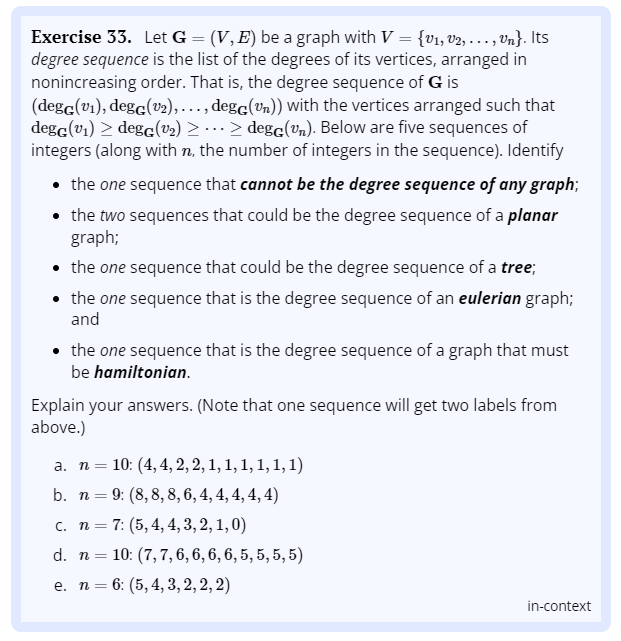
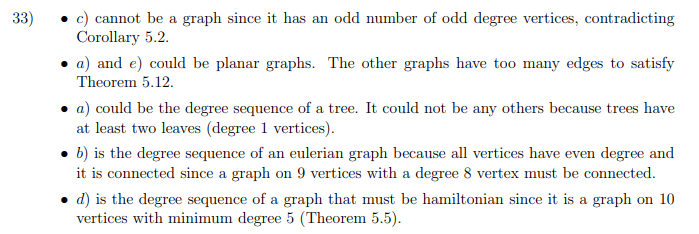
33) c) cannot be a graph since it has an odd number of odd degree yertices, contradicting Iorollary 5.2. a] and a] could be planar graphs. The other graphs have too many edges to satisfyr Theorem 5.12. a] could be the degree sequence of a tree. It could not be any others because trees have at least two leaves {degree 1 yertices]. b] is the degree sequence of an eulerian graph because all yertices have even degree and it. is connected since a graph on 9 yertices with a degree 8 1.rerteznc must be connected. [I] is the degree sequence of a graph that must be harniltonian since it is a graph on ll] yertices with minimum degree 5 [Theorem 5.5]. 34. Below are three sequences of length 10. One of the sequences cannot be the degree sequence (see Exercise 5.9.33) of any graph. Identify it and say why. For each of the other two, say why (if you have enough information) a connected graph with that degree sequence . is definitely hamiltonian/cannot be hamiltonian; . is definitely eulerian/cannot be eulerian; . is definitely a tree/cannot be a tree; and . is definitely planar/cannot be planar. (If you do not have enough information to make a determination for a sequence without having specific graph(s) with that degree sequence, write "not enough information" for that property.) a. (6, 6, 4, 4, 4, 4, 2, 2, 2, 2) b. (7, 7, 7, 7, 6, 6, 6, 2, 1, 1) C. (8, 6, 4, 4, 4, 3, 2, 2, 1, 1)Exercise 33. Let G = (V, E) be a graph with V = {v1, v2, . .., Un}. Its degree sequence is the list of the degrees of its vertices, arranged in nonincreasing order. That is, the degree sequence of G is (degc(v1), degg(12), ..., degg(Un)) with the vertices arranged such that degc(v1) > degg(v2) > ... > degg(Un). Below are five sequences of integers (along with n, the number of integers in the sequence). Identify . the one sequence that cannot be the degree sequence of any graph; . the two sequences that could be the degree sequence of a planar graph; . the one sequence that could be the degree sequence of a tree; . the one sequence that is the degree sequence of an eulerian graph; and . the one sequence that is the degree sequence of a graph that must be hamiltonian. Explain your answers. (Note that one sequence will get two labels from above.) a. n = 10: (4, 4, 2, 2, 1, 1, 1, 1, 1, 1) b. n = 9: (8, 8, 8, 6, 4, 4, 4, 4, 4) c. n = 7: (5, 4, 4, 3, 2, 1, 0) d. n = 10: (7, 7, 6, 6, 6, 6, 5, 5, 5, 5) e. n = 6: (5, 4, 3, 2, 2, 2) in-context
Step by Step Solution
There are 3 Steps involved in it

Get step-by-step solutions from verified subject matter experts
 Study Help