







Question: *33. Consider two M / M / 1 queues with respective parameters in, m, i = 1, 2. Suppose they share a common waiting room
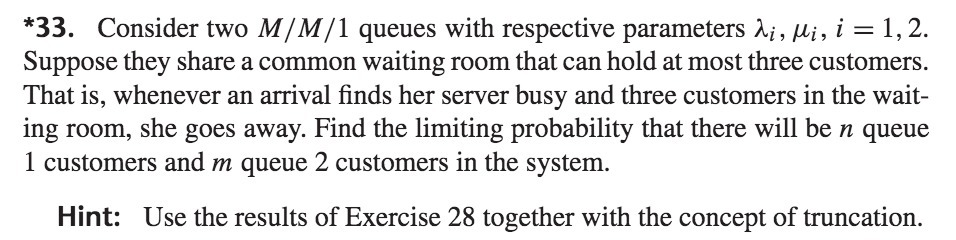
*33. Consider two M / M / 1 queues with respective parameters in, m, i = 1, 2. Suppose they share a common waiting room that can hold at most three customers. That is, whenever an arrival nds her server busy and three customers in the wait- ing room, she goes away. Find the limiting probability that there will be :1 queue 1 customers and m queue 2 customers in the system. Hint: Use the results of Exercise 28 together with the concept of trunoation
Step by Step Solution
There are 3 Steps involved in it
1 Expert Approved Answer
Step: 1 Unlock

Question Has Been Solved by an Expert!
Get step-by-step solutions from verified subject matter experts
Step: 2 Unlock
Step: 3 Unlock
 Study Help