



Question: 33.) The final part of the strategy formulation process is a. formulation of business-level strategies. b. formulation of functional-level strategies. c. formulation of corporate-level
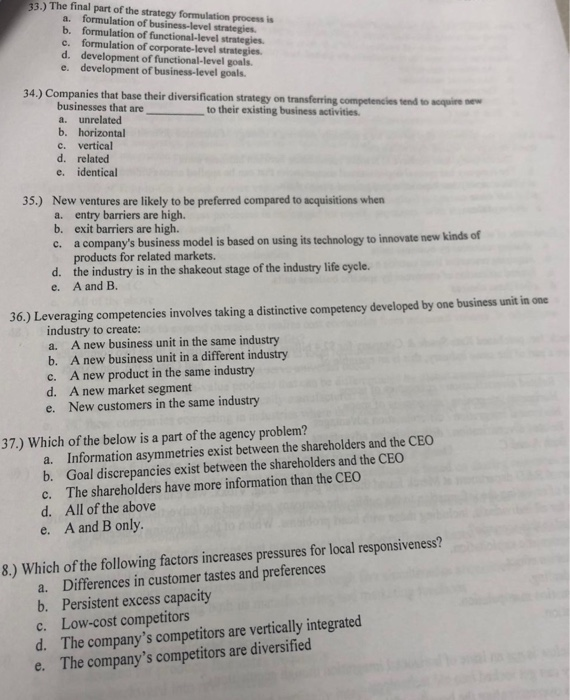
33.) The final part of the strategy formulation process is a. formulation of business-level strategies. b. formulation of functional-level strategies. c. formulation of corporate-level strategies. d. development of functional-level goals. e. development of business-level goals. 34.) Companies that base their diversification strategy on transferring competencies tend to acquire new businesses that are to their existing business activities. a. unrelated b. horizontal c. vertical d. related e. identical 35.) New ventures are likely to be preferred compared to acquisitions when a. entry barriers are high. b. exit barriers are high. C. a company's business model is based on using its technology to innovate new kinds of products for related markets. d. the industry is in the shakeout stage of the industry life cycle. e. A and B. 36.) Leveraging competencies involves taking a distinctive competency developed by one business unit in one industry to create: a. A new business unit in the same industry b. A new business unit in a different industry A new product in the same industry A new market segment e. New customers in the same industry C. d. 37.) Which of the below is a part of the agency problem? a. Information asymmetries exist between the shareholders and the CEO b. Goal discrepancies exist between the shareholders and the CEO c. The shareholders have more information than the CEO d. All of the above e. A and B only. 8.) Which of the following factors increases pressures for local responsiveness? a. Differences in customer tastes and preferences b. Persistent excess capacity c. Low-cost competitors d. The company's competitors are vertically integrated e. The company's competitors are diversified
Step by Step Solution
3.47 Rating (154 Votes )
There are 3 Steps involved in it
ANSWER 1 A Formulation of business level strategies The business level strategy formulation is based upon the generic strategies of overall cost leadership differentiation and focus For example your f... View full answer

Get step-by-step solutions from verified subject matter experts