



Question: 3.3.2 (a) With reference to part (a) of Example 3.6, suppose the loan amount of 100,000 was not given, but rather that the bor- rower's
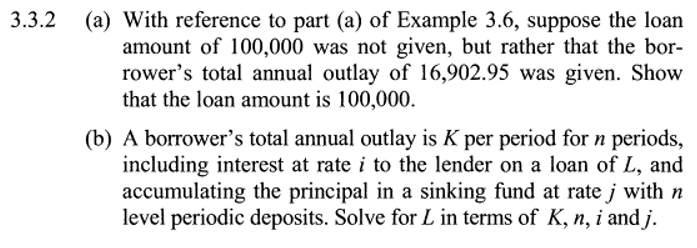
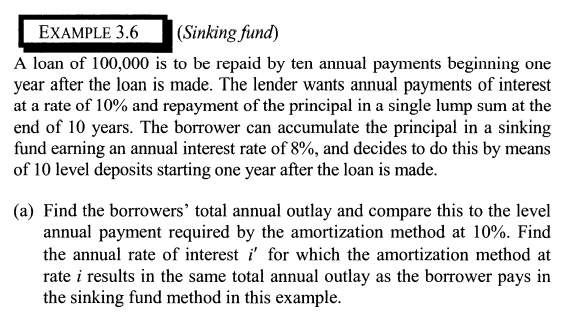
3.3.2 (a) With reference to part (a) of Example 3.6, suppose the loan amount of 100,000 was not given, but rather that the bor- rower's total annual outlay of 16,902.95 was given. Show that the loan amount is 100,000. (b) A borrower's total annual outlay is K per period for n periods, including interest at rate i to the lender on a loan of L, and accumulating the principal in a sinking fund at rate j with n level periodic deposits. Solve for L in terms of K, n, i and j. EXAMPLE 3.6 (Sinking fund) A loan of 100,000 is to be repaid by ten annual payments beginning one year after the loan is made. The lender wants annual payments of interest at a rate of 10% and repayment of the principal in a single lump sum at the end of 10 years. The borrower can accumulate the principal in a sinking fund earning an annual interest rate of 8%, and decides to do this by means of 10 level deposits starting one year after the loan is made. (a) Find the borrowers total annual outlay and compare this to the level annual payment required by the amortization method at 10%. Find the annual rate of interest i' for which the amortization method at rate i results in the same total annual outlay as the borrower pays in the sinking fund method in this example. 3.3.2 (a) With reference to part (a) of Example 3.6, suppose the loan amount of 100,000 was not given, but rather that the bor- rower's total annual outlay of 16,902.95 was given. Show that the loan amount is 100,000. (b) A borrower's total annual outlay is K per period for n periods, including interest at rate i to the lender on a loan of L, and accumulating the principal in a sinking fund at rate j with n level periodic deposits. Solve for L in terms of K, n, i and j. EXAMPLE 3.6 (Sinking fund) A loan of 100,000 is to be repaid by ten annual payments beginning one year after the loan is made. The lender wants annual payments of interest at a rate of 10% and repayment of the principal in a single lump sum at the end of 10 years. The borrower can accumulate the principal in a sinking fund earning an annual interest rate of 8%, and decides to do this by means of 10 level deposits starting one year after the loan is made. (a) Find the borrowers total annual outlay and compare this to the level annual payment required by the amortization method at 10%. Find the annual rate of interest i' for which the amortization method at rate i results in the same total annual outlay as the borrower pays in the sinking fund method in this example
Step by Step Solution
There are 3 Steps involved in it

Get step-by-step solutions from verified subject matter experts