





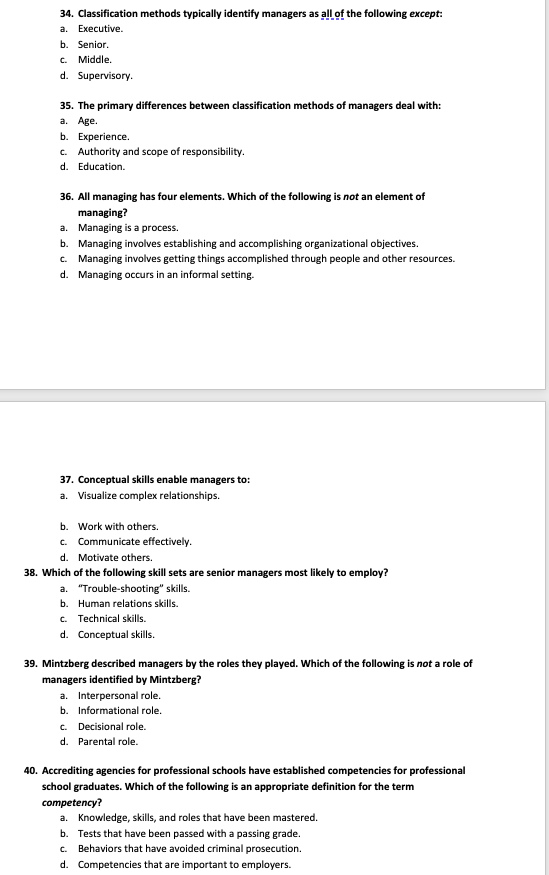
Question: 34. Classification methods typically identify managers as all of the following except: a. Executive. b. Senior. c. Middle. d. Supervisory. 35. The primary differences between
34. Classification methods typically identify

34. Classification methods typically identify

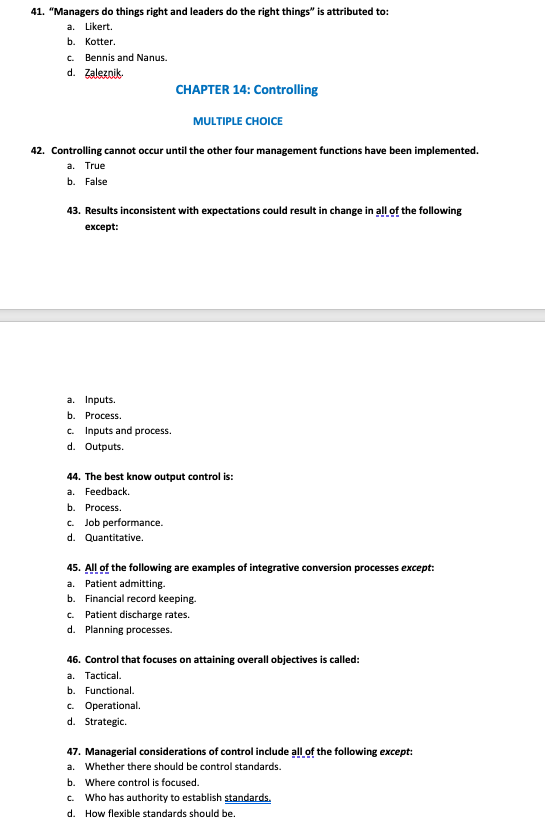
34. Classification methods typically identify managers as all of the following except: a. Executive. b. Senior. c. Middle. d. Supervisory. 35. The primary differences between classification methods of managers deal with: a. Age. b. Experience. c Authority and scope of responsibility. d. Education 36. All managing has four elements. Which of the following is not an element of managing? a. Managing is a process. b. Managing involves establishing and accomplishing organizational objectives. c Managing involves getting things accomplished through people and other resources. d. Managing occurs in an informal setting. 37. Conceptual skills enable managers to: a. Visualize complex relationships. b. Work with others. c Communicate effectively. d. Motivate others. 38. Which of the following skill sets are senior managers most likely to employ? a. "Trouble-shooting" skills. b. Human relations skills. c. Technical skills. d. Conceptual skills. 39. Mintzberg described managers by the roles they played. Which of the following is not a role of managers identified by Mintzberg? a. Interpersonal role. b. Informational role. c. Decisional role. d. Parental role. 40. Accrediting agencies for professional schools have established competencies for professional school graduates. Which of the following is an appropriate definition for the term competency? a. Knowledge, skills, and roles that have been mastered. b. Tests that have been passed with a passing grade. c. Behaviors that have avoided criminal prosecution. d. Competencies that are important to employers. 41. "Managers do things right and leaders do the right things" is attributed to: a. Likert. b. Kotter. c. Bennis and Nanus. d. Zaleznik CHAPTER 14: Controlling MULTIPLE CHOICE 42. Controlling cannot occur until the other four management functions have been implemented. a. True b. False 43. Results inconsistent with expectations could result in change in all of the following except: a. Inputs. b. Process c. Inputs and process. d. Outputs. 44. The best know output control is: a. Feedback. b. Process. c. Job performance. d. Quantitative. 45. All of the following are examples of integrative conversion processes except: a. Patient admitting b. Financial record keeping. c. Patient discharge rates. d. Planning processes. 46. Control that focuses on attaining overall objectives is called: a. Tactical. b. Functional c. Operational d. Strategic 47. Managerial considerations of control include all of the following except: a. Whether there should be control standards. b. Where control is focused. c. Who has authority to establish standards. d. How flexible standards should be

Step by Step Solution

There are 3 Steps involved in it

1 Expert Approved Answer
Step: 1 Unlock blur-text-image

Question Has Been Solved by an Expert!

Get step-by-step solutions from verified subject matter experts

Step: 2 Unlock
Step: 3 Unlock

Students Have Also Explored These Related General Management Questions!