







Question: 3.4.1 Computer Representation of Numbers Numerical round-off errors are directly related to the manner in which numbers are stored in a computer. The fundamental unit
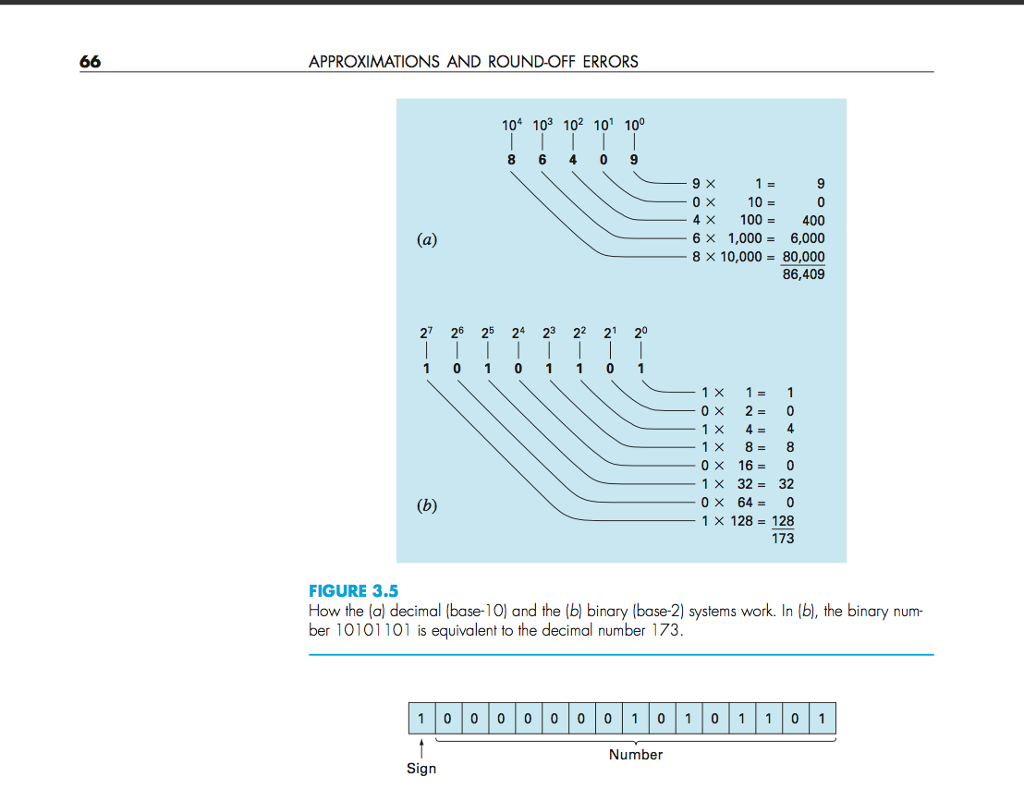
3.4.1 Computer Representation of Numbers Numerical round-off errors are directly related to the manner in which numbers are stored in a computer. The fundamental unit whereby information is represented is called a word. This is an entity that consists of a string of binary digits, or bits. Numbers are typically stored in one or more words. To understand how this is accomplished, we must first review some material related to number systems. Number Systems. A number system is merely a convention for representing quantities Because we have 10 fingers and 10 toes, the number system that we are most familiar with is the decimal, or base-10, number system. A base is the number used as the refer ence for constructing the system. The base-10 system uses the 10 digits-0, 1, 2, 3, 4, 5, 6, 7, 8, 9-to represent numbers. By themselves, these digits are satisfactory for counting from 0 to 9 For larger quantities, combinations of these basic digits are used, with the position or place value specifying the magnitude. The right-most digit in a whole number repre sents a number from 0 to 9. The second digit from the right represents a multiple of 10. The third digit from the right represents a multiple of 100 and so on. For example, if we have the number 86,409 then we have eight groups of 10,000, six groups of 1000 four groups of 100, zero groups of 10, and nine more units, or (8 104) (6 103) (4 102) + (OX 10') (9 100) = 86,409 Figure 3.5a provides a visual representation of how a number is formulated in the base-10 system. This type of representation is called positional notation. Because the decimal system is so familiar, it is not commonly realized that there are alternatives. For example, if human beings happened to have had eight fingers and eight toes, we would undoubtedly have developed an octal, or base-8, representation. In the same sense, our friend the computer is like a two-fingered animal who is limited to two states-either 0 or 1. This relates to the fact that the primary logic units of digital com puters are on/off electronic components. Hence, numbers on the computer are represented with a binary, or base-2, system. Just as with the decimal system, quantities can be represented using positional notation. For example, the binary number 11 is equivalent to (1 21) + (1 20) = 2 + 1 = 3 in the decimal system. Figure 3.5b illustrates a more complicated example Integer Representation. Now that we have reviewed how base-10 numbers can be represented in binary form, it is simple to conceive of how integers are represented on a computer. The most straightforward approach, called the signed magnitude method, employs the first bit of a word to indicate the sign, with a 0 for positive and a 1 for
Step by Step Solution
There are 3 Steps involved in it

Get step-by-step solutions from verified subject matter experts
 Study Help