



Question: (3.5 points) A local firm recently purchased a stamping machine (newer model) to be used alongside its current stamping machine (old). Only one machine
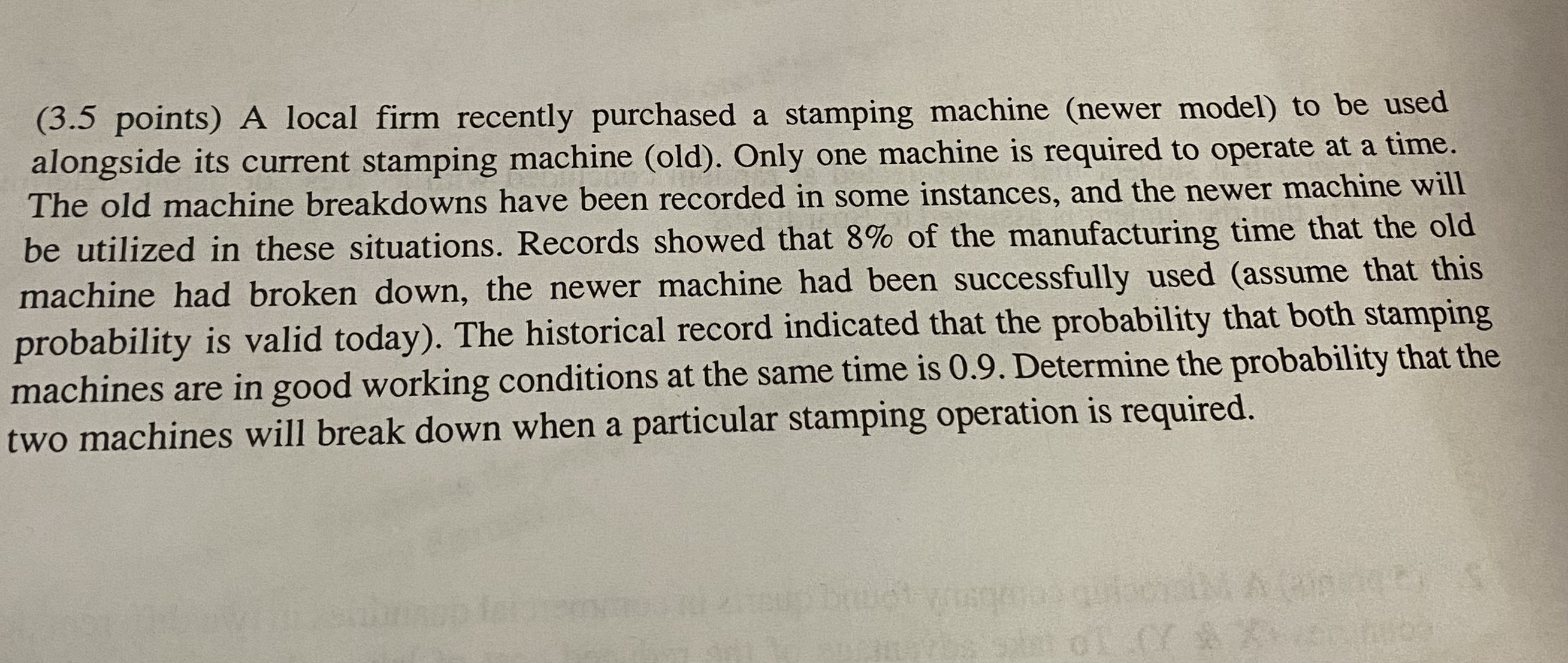
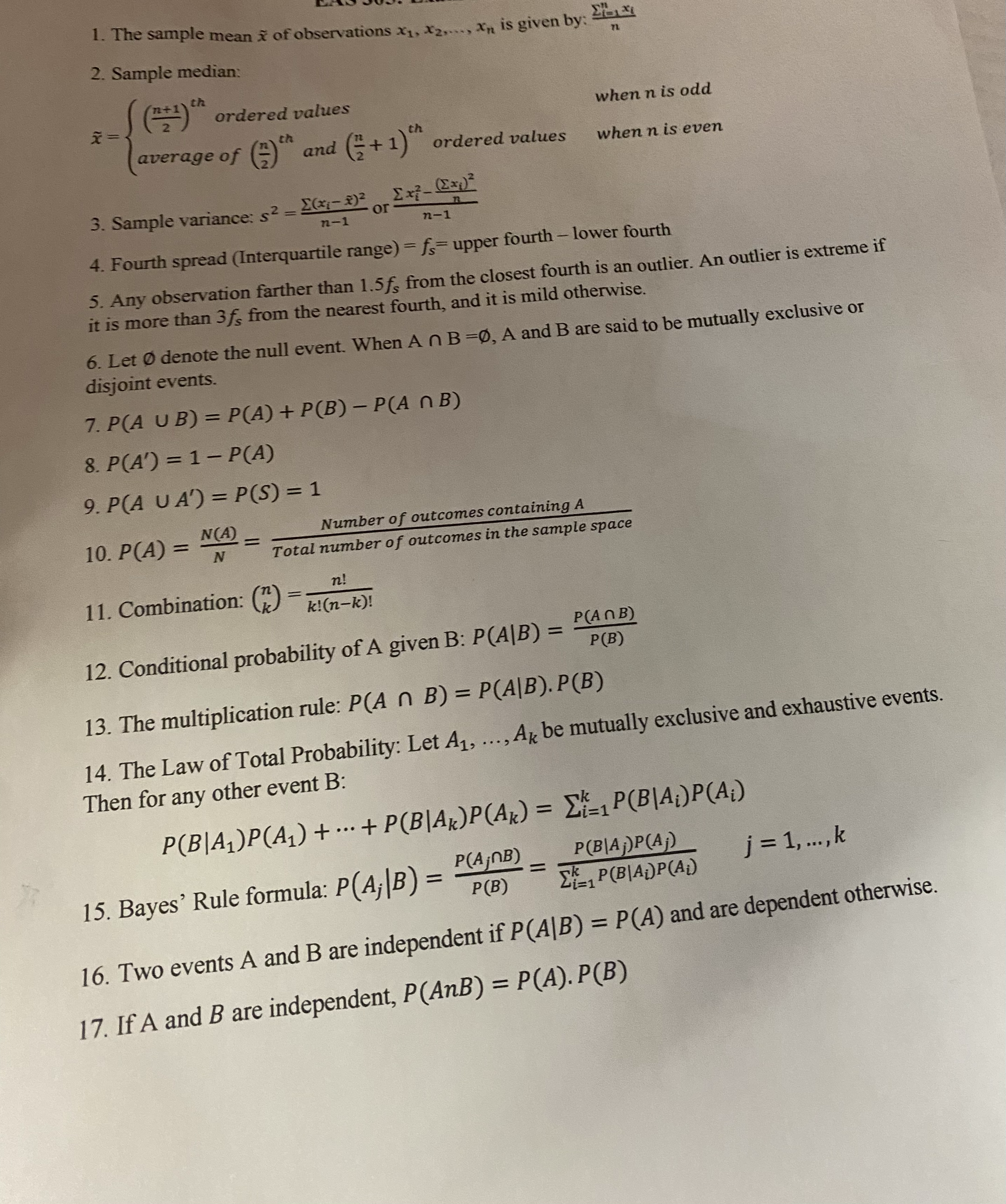
(3.5 points) A local firm recently purchased a stamping machine (newer model) to be used alongside its current stamping machine (old). Only one machine is required to operate at a time. The old machine breakdowns have been recorded in some instances, and the newer machine will be utilized in these situations. Records showed that 8% of the manufacturing time that the old machine had broken down, the newer machine had been successfully used (assume that this probability is valid today). The historical record indicated that the probability that both stamping machines are in good working conditions at the same time is 0.9. Determine the probability that the two machines will break down when a particular stamping operation is required. brudt visqas quicia A (aising 1. The sample mean x of observations x1, x2,..., x is given by: 2. Sample median: x= (n+1)th ordered values average of (4)th and (+1)th ordered values 71 when n is odd when n is even 3. Sample variance: 5 = (x-x) n-1 Lxf- (Px1)2 or 72 n-1 4. Fourth spread (Interquartile range) = fs= upper fourth - lower fourth 5. Any observation farther than 1.5fs from the closest fourth is an outlier. An outlier is extreme if it is more than 3fs from the nearest fourth, and it is mild otherwise. 6. Let denote the null event. When An B=0, A and B are said to be mutually exclusive or disjoint events. - 7. P(A UB) = P(A) + P(B) = P(A n B) 8. P(A') = 1-P(A) 9. P(A U A') = P(S) = 1 10. P(A) = N(A) N Number of outcomes containing A Total number of outcomes in the sample space n! 11. Combination: () = k!(n-k)! 12. Conditional probability of A given B: P(A|B) = P(ANB) P(B) 13. The multiplication rule: P(A n B) = P(A|B).P(B) 14. The Law of Total Probability: Let A1, ..., Ak be mutually exclusive and exhaustive events. Then for any other event B: P(B\A)P(A) + P(B\Ak)P(A) = P(BIA)P(A) =1 15. Bayes' Rule formula: P(A|B) = = P(AjB) = P(BA)P(A) j = 1, ..., k P(B) i=1 P(B|A)P(A) 16. Two events A and B are independent if P(A|B) = P(A) and are dependent otherwise. 17. If A and B are independent, P(AnB) = P(A). P(B)
Step by Step Solution
There are 3 Steps involved in it

Get step-by-step solutions from verified subject matter experts