







Question: [35 points] In this problem, we study the popular card game Blackjack, also known as twenty- one. In our simplfied and modified version of the
![[35 points] In this problem, we study the popular card game](https://dsd5zvtm8ll6.cloudfront.net/si.experts.images/questions/2024/10/6703fe202b34b_9116703fe1fa6d33.jpg)
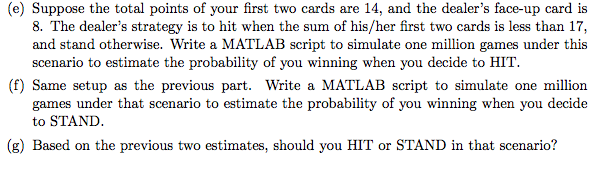
[35 points] In this problem, we study the popular card game Blackjack, also known as twenty- one. In our simplfied and modified version of the game, the dealer draws cards from an infinite number of well-shuffled decks of 52 cards. Therefore, the probability of getting each of the 13 ranks ( Ace, 2, 3, , 10, Jack, Queen, King) in each drawing is simply Note the suits (spades, hearts, diamonds, and clubs) do not matter for this game. When the game starts, both you and the dealer will get two cards. While both your cards are face-up, only the first card of the dealer is revealed and her/his second card faces down. After receiving your first two cards, you next choose to "hit" (take a third card and end your turn) or "stand" (do not take a third card and end your turn). There is no double or split for our version of the game The dealer will do the same after you. Both you and the dealer will get at most three cards. (In a real game, the player and the dealer can take multiple turns to hit or stand). You and the dealer get points by adding together the values of your cards. Face cards (Kings, Queens and Jacks) are counted as ten points. Ace is always counted as 11 points (which is different from the usual twenty-one). All other cards are counted as the numeric value shown on the I. Your objective is to beat the dealer in one of the following ways: . Get 21 points on your first two cards (called a "blackjack"); . Let the dealer's points exceed 21 (called "bust") before you do; or Reach a final score strictly higher than the dealer without bust
Step by Step Solution
There are 3 Steps involved in it

Get step-by-step solutions from verified subject matter experts
 Study Help