



Question: 3.5-4 TCP sequence numbers and ACKs (2). Suppose that as shown in the figure below, a TCP sender is sending segments with 100 bytes of
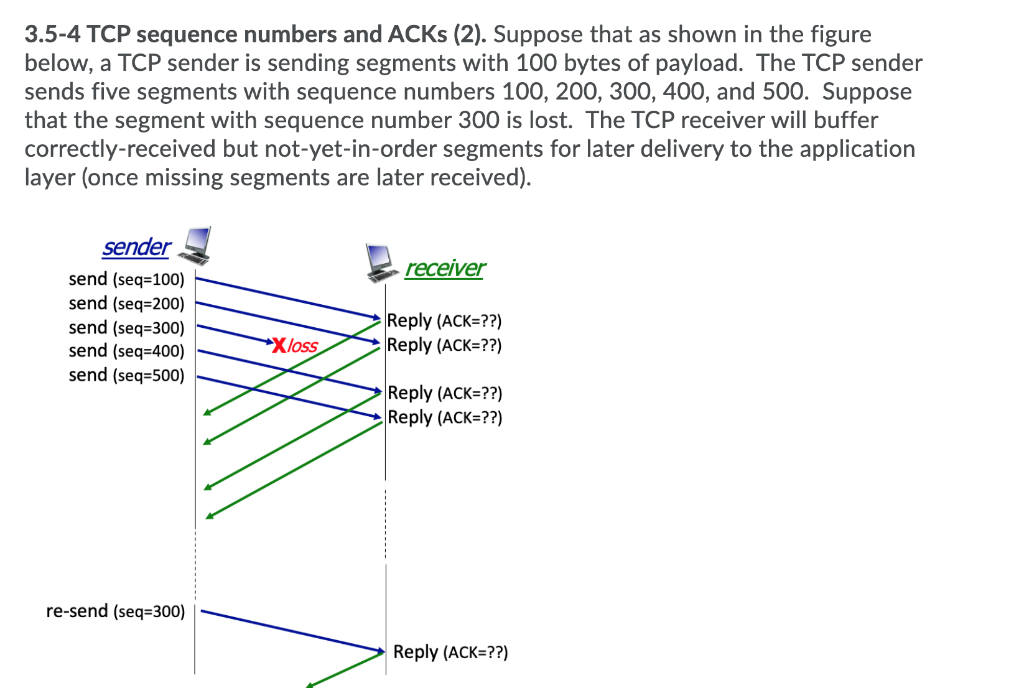
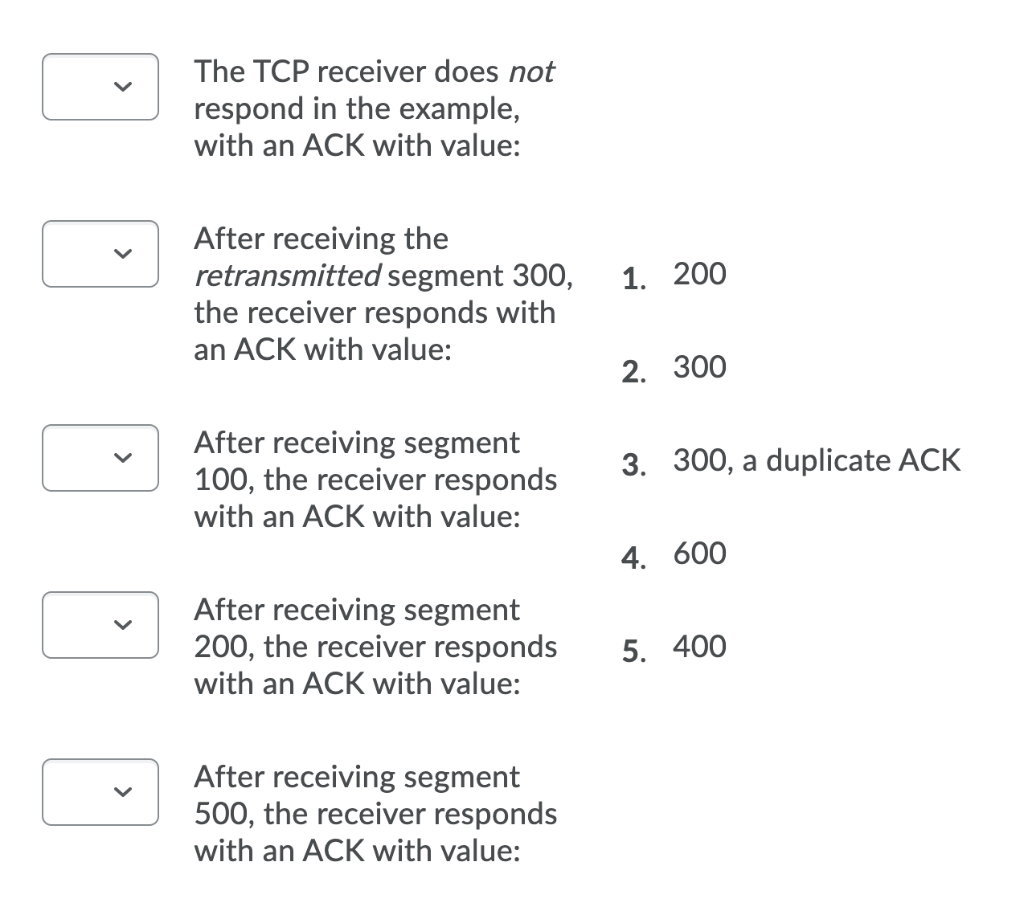
3.5-4 TCP sequence numbers and ACKs (2). Suppose that as shown in the figure below, a TCP sender is sending segments with 100 bytes of payload. The TCP sender sends five segments with sequence numbers 100, 200, 300, 400, and 500. Suppose that the segment with sequence number 300 is lost. The TCP receiver will buffer correctly-received but not-yet-in-order segments for later delivery to the application layer (once missing segments are later received). receiver sender send (seq=100) send (seq=200) send (seq=300) send (seq=400) send (seq=500) Reply (ACK=??) Reply (ACK=??) Xloss Reply (ACK=??) Reply (ACK=??) re-send (seq=300) Reply (ACK=??) The TCP receiver does not respond in the example, with an ACK with value: After receiving the retransmitted segment 300, the receiver responds with an ACK with value: 1. 200 2. 300 After receiving segment 100, the receiver responds with an ACK with value: 3. 300, a duplicate ACK 4. 600 After receiving segment 200, the receiver responds with an ACK with value: 5. 400 After receiving segment 500, the receiver responds with an ACK with value
Step by Step Solution
There are 3 Steps involved in it

Get step-by-step solutions from verified subject matter experts