







Question: 38. The difference between an ordinary annuity and an annuity due is determined by a. Who the payment is DUE to. b. Whether we are
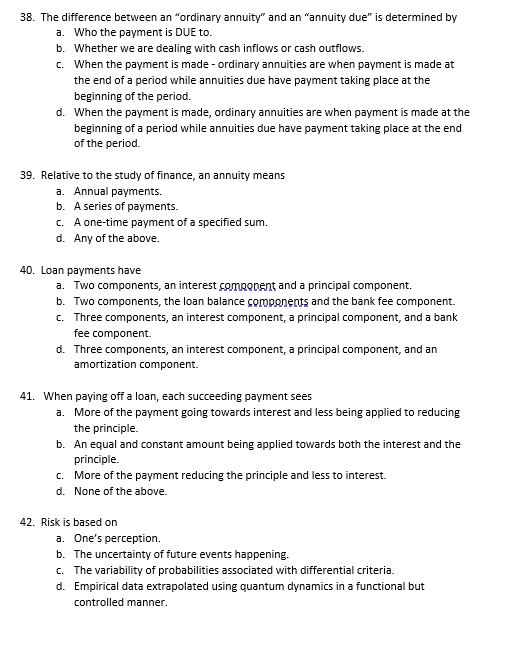
38. The difference between an "ordinary annuity" and an "annuity due" is determined by a. Who the payment is DUE to. b. Whether we are dealing with cash inflows or cash outflows. c. When the payment is made - ordinary annuities are when payment is made at the end of a period while annuities due have payment taking place at the beginning of the period. d. When the payment is made, ordinary annuities are when payment is made at the beginning of a period while annuities due have payment taking place at the end of the period. 39. Relative to the study of finance, an annuity means a. Annual payments. b. A series of payments. c. A one-time payment of a specified sum. d. Any of the above. 40. Loan payments have a. Two components, an interest component and a principal component. b. Two components, the loan balance components and the bank fee component. c. Three components, an interest component, a principal component, and a bank fee component. d. Three components, an interest component, a principal component, and an amortization component. 41. When paying off a loan, each succeeding payment sees a. More of the payment going towards interest and less being applied to reducing the principle. b. An equal and constant amount being applied towards both the interest and the principle. c. More of the payment reducing the principle and less to interest. d. None of the above. 42. Risk is based on a. One's perception. b. The uncertainty of future events happening. c. The variability of probabilities associated with differential criteria. d. Empirical data extrapolated using quantum dynamics in a functional but controlled manner
Step by Step Solution
There are 3 Steps involved in it

Get step-by-step solutions from verified subject matter experts
 Study Help