







Question: 39) What is the main factor that determines the power of a muscle? A) the length B) the shape C) the total number of
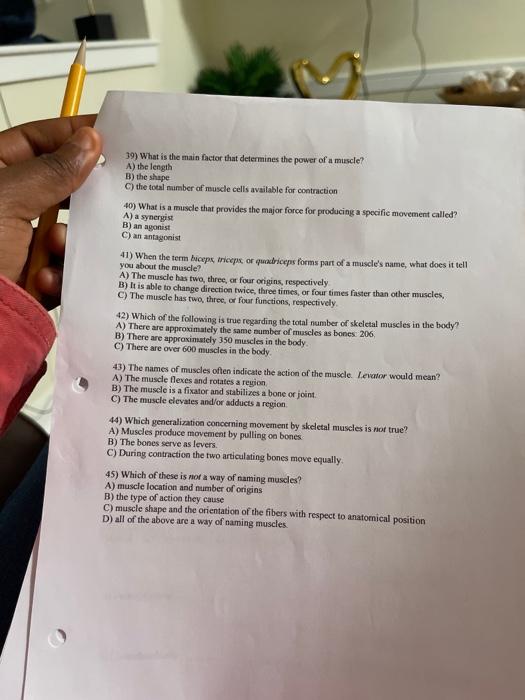
39) What is the main factor that determines the power of a muscle? A) the length B) the shape C) the total number of muscle cells available for contraction 40) What is a muscle that provides the major force for producing a specific movement called? A) a synergist B) an agonist C) an antagonist 41) When the term biceps, triceps, or quadriceps forms part of a muscle's name, what does it tell you about the muscle? A) The muscle has two, three, or four origins, respectively. B) It is able to change direction twice, three times, or four times faster than other muscles, C) The muscle has two, three, or four functions, respectively. 42) Which of the following is true regarding the total number of skeletal muscles in the body? A) There are approximately the same number of muscles as bones: 206 B) There are approximately 350 muscles in the body. C) There are over 600 muscles in the body. 43) The names of muscles often indicate the action of the muscle. Levator would mean? A) The muscle flexes and rotates a region B) The muscle is a fixator and stabilizes a bone or joint C) The muscle elevates and/or adducts a region 44) Which generalization concerning movement by skeletal muscles is not true? A) Muscles produce movement by pulling on bones B) The bones serve as levers. C) During contraction the two articulating bones move equally. 45) Which of these is not a way of naming muscles? A) muscle location and number of origins B) the type of action they cause C) muscle shape and the orientation of the fibers with respect to anatomical position D) all of the above are a way of naming muscles.
Step by Step Solution
3.43 Rating (156 Votes )
There are 3 Steps involved in it
39 The correct answer is C The total number of muscle cells available for contrac... View full answer

Get step-by-step solutions from verified subject matter experts
 Study Help