







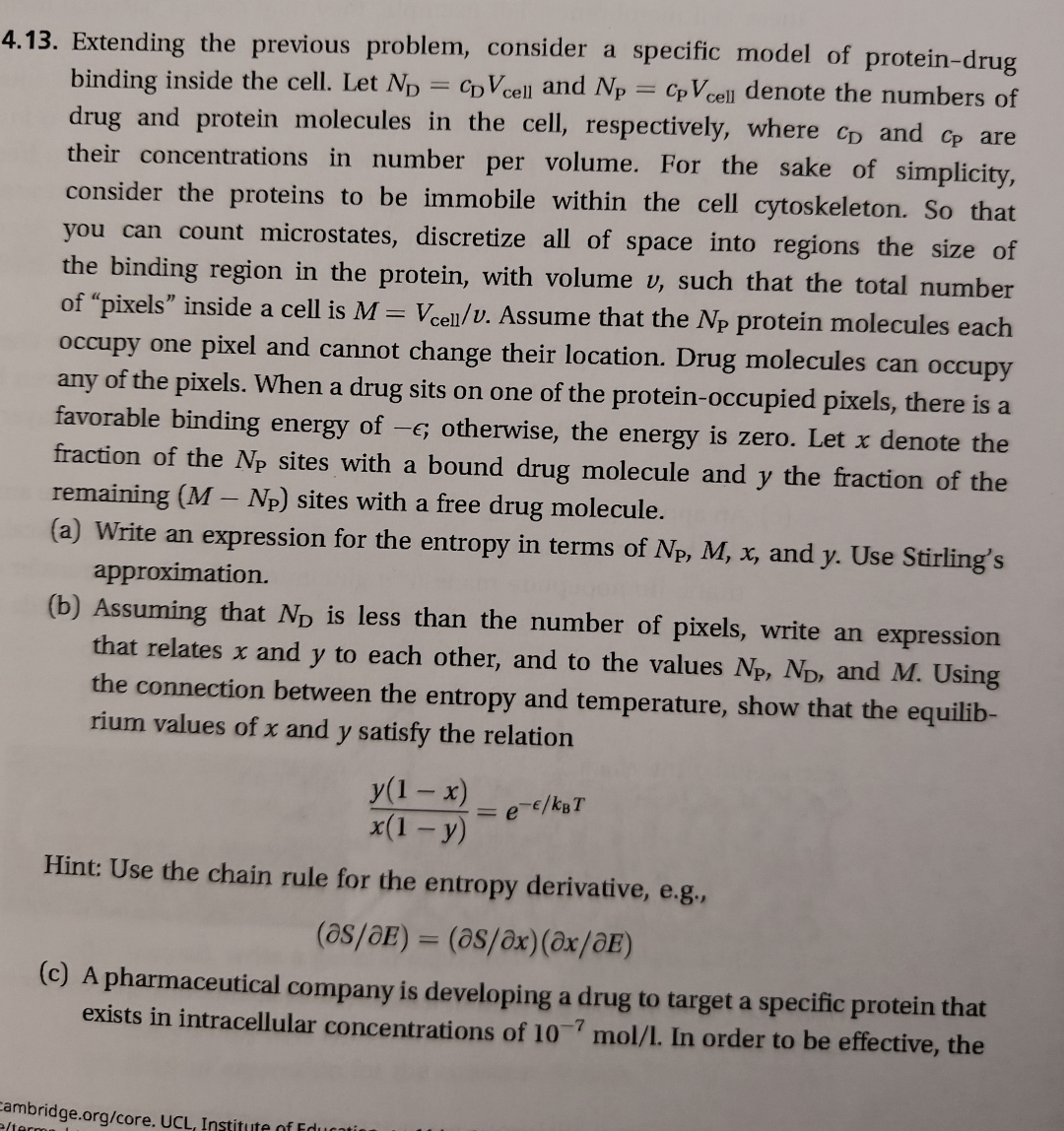
Question: 4 . 1 3 . Extending the previous problem, consider a specific model of protein - drug binding inside the cell. Let N D =
Extending the previous problem, consider a specific model of proteindrug binding inside the cell. Let and denote the numbers of drug and protein molecules in the cell, respectively, where and are their concentrations in number per volume. For the sake of simplicity, consider the proteins to be immobile within the cell cytoskeleton. So that you can count microstates, discretize all of space into regions the size of the binding region in the protein, with volume such that the total number of "pixels" inside a cell is Assume that the protein molecules each occupy one pixel and cannot change their location. Drug molecules can occupy any of the pixels. When a drug sits on one of the proteinoccupied pixels, there is a favorable binding energy of ; otherwise, the energy is zero. Let denote the fraction of the sites with a bound drug molecule and the fraction of the remaining sites with a free drug molecule.
a Write an expression for the entropy in terms of and Use Stirling's approximation.
b Assuming that is less than the number of pixels, write an expression that relates and to each other, and to the values and Using the connection between the entropy and temperature, show that the equilibrium values of and satisfy the relation
Hint: Use the chain rule for the entropy derivative, eg
elEelxelE
c A pharmaceutical company is developing a drug to target a specific protein that exists in intracellular concentrations of In order to be effective, the
Step by Step Solution
There are 3 Steps involved in it
1 Expert Approved Answer
Step: 1 Unlock

Question Has Been Solved by an Expert!
Get step-by-step solutions from verified subject matter experts
Step: 2 Unlock
Step: 3 Unlock
 Study Help