







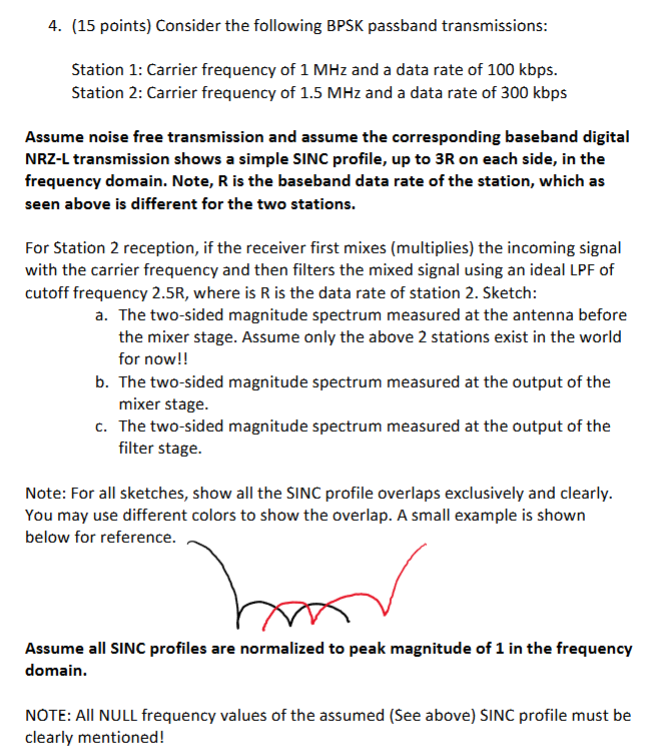
Question: 4 . ( 1 5 points ) Consider the following BPSK passband transmissions: Station 1 : Carrier frequency of 1 MHz and a data rate
points Consider the following BPSK passband transmissions:
Station : Carrier frequency of MHz and a data rate of kbps
Station : Carrier frequency of MHz and a data rate of kbps
Assume noise free transmission and assume the corresponding baseband digital NRZL transmission shows a simple SINC profile, up to R on each side, in the frequency domain. Note, R is the baseband data rate of the station, which as seen above is different for the two stations.
For Station reception, if the receiver first mixes multiplies the incoming signal with the carrier frequency and then filters the mixed signal using an ideal LPF of cutoff frequency R where is R is the data rate of station Sketch:
a The twosided magnitude spectrum measured at the antenna before the mixer stage. Assume only the above stations exist in the world for now!!
b The twosided magnitude spectrum measured at the output of the mixer stage.
c The twosided magnitude spectrum measured at the output of the filter stage.
Note: For all sketches, show all the SINC profile overlaps exclusively and clearly. You may use different colors to show the overlap. A small example is shown below for referenc
Assume all SINC profiles are normalized to peak magnitude of in the frequency domain.
NOTE: All NULL frequency values of the assumed See above SINC profile must be clearly mentioned!
Step by Step Solution
There are 3 Steps involved in it
1 Expert Approved Answer
Step: 1 Unlock

Question Has Been Solved by an Expert!
Get step-by-step solutions from verified subject matter experts
Step: 2 Unlock
Step: 3 Unlock
 Study Help