



Question: 4. /10 points): More and more parole boards are using risk assessment tools when trying to determine an individual's likelihood of returning to crime. Most
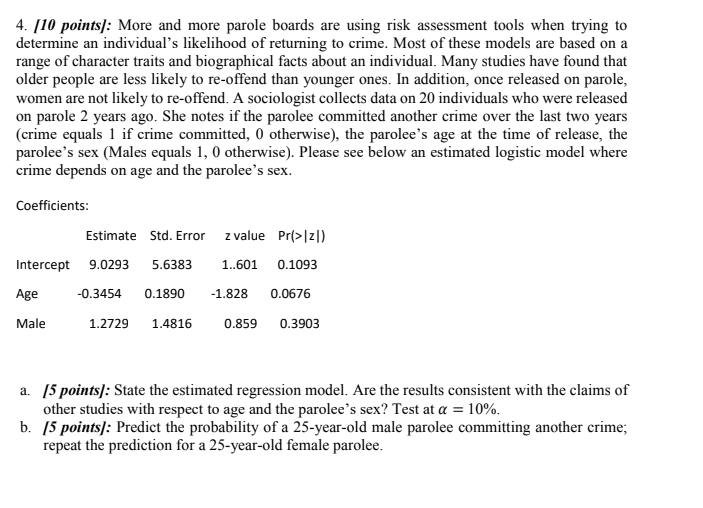
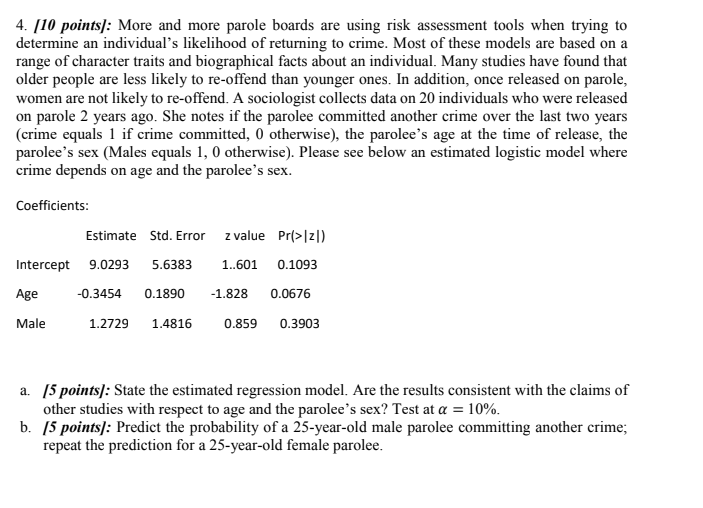
4. /10 points): More and more parole boards are using risk assessment tools when trying to determine an individual's likelihood of returning to crime. Most of these models are based on a range of character traits and biographical facts about an individual. Many studies have found that older people are less likely to re-offend than younger ones. In addition, once released on parole, women are not likely to re-offend. A sociologist collects data on 20 individuals who were released on parole 2 years ago. She notes if the parolee committed another crime over the last two years (crime equals 1 if crime committed, 0 otherwise), the parolee's age at the time of release, the parolee's sex (Males equals 1, 0 otherwise). Please see below an estimated logistic model where crime depends on age and the parolee's sex. Coefficients: Estimate Std. Error zvalue Pr(>|z)) Intercept 9.0293 5.6383 1..601 0.1093 Age -0.3454 0.1890 -1.828 0.0676 Male 1.2729 1.4816 0.859 0.3903 a. /5 points): State the estimated regression model. Are the results consistent with the claims of other studies with respect to age and the parolee's sex? Test at a = 10% b. /5 points): Predict the probability of a 25-year-old male parolee committing another crime; repeat the prediction for a 25-year-old female parolee
Step by Step Solution
There are 3 Steps involved in it

Get step-by-step solutions from verified subject matter experts