







Question: 4. [16 pts] Let n 2 4 be an integer, and let G be a 2 x n-grid graph.(a) [8 pts] Find the number of
![4. [16 pts] Let n 2 4 be an integer, and](https://dsd5zvtm8ll6.cloudfront.net/si.experts.images/questions/2024/10/6706d337e51f6_5356706d337d8aed.jpg)
![let G be a 2 x n-grid graph.(a) [8 pts] Find the](https://dsd5zvtm8ll6.cloudfront.net/si.experts.images/questions/2024/10/6706d338297ac_5366706d3381ddc8.jpg)
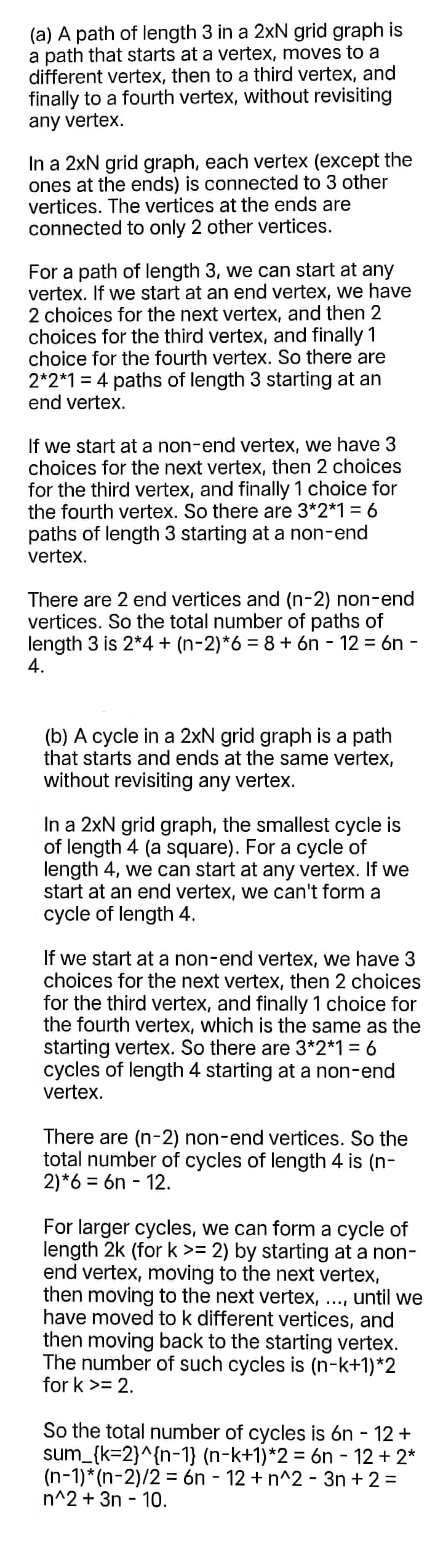
4. [16 pts] Let n 2 4 be an integer, and let G be a 2 x n-grid graph.(a) [8 pts] Find the number of paths of length 3 in G in terms of n. Justify your answer. (b) [8 pts] Find the number of cycles in G in terms of n. Justify your answer.(a) A path of length 3 in a 2xN grid graph is a path that starts at a vertex, moves to a different vertex, then to a third vertex, and finally to a fourth vertex, without revisiting any vertex. In a 2xN grid graph, each vertex (except the ones at the ends) is connected to 3 other vertices. The vertices at the ends are connected to only 2 other vertices. For a path of length 3, we can start at any vertex. If we start at an end vertex, we have 2 choices for the next vertex, and then 2 choices for the third vertex, and finally 1 choice for the fourth vertex. So there are 2*2*1 = 4 paths of length 3 starting at an end vertex. If we start at a non-end vertex, we have 3 choices for the next vertex, then 2 choices for the third vertex, and finally 1 choice for the fourth vertex. So there are 3*2*1=6 paths of length 3 starting at a non-end vertex. There are 2 end vertices and (n-2) non-end vertices. So the total number of paths of length 3is 2*4 + (N-2)*6 =8+ 6n-12=6n - 4. (b) A cycle in a 2xN grid graph is a path that starts and ends at the same vertex, without revisiting any vertex. In a 2xN grid graph, the smallest cycle is of length 4 (a square). For a cycle of length 4, we can start at any vertex. If we start at an end vertex, we can't form a cycle of length 4. If we start at a non-end vertex, we have 3 choices for the next vertex, then 2 choices for the third vertex, and finally 1 choice for the fourth vertex, which is the same as the starting vertex. So there are 3*2*1=6 cycles of length 4 starting at a non-end vertex. There are (n-2) non-end vertices. So the total number of cycles of length 4 is (n- 2)*6=6n -12. For larger cycles, we can form a cycle of length 2k (for k >= 2) by starting at a non- end vertex, moving to the next vertex, then moving to the next vertex, ..., until we have moved to k different vertices, and then moving back to the starting vertex. The number of such cycles is (n-k+1)*2 fork >=2. So the total number of cycles is 6n - 12 + sum_{k=2}*{n-1} (n-k+1)*2 = 6n - 12 + 2* (N-1*(n-2)/2=6n-124+n"2-3n+2= n*2+3n - 10
Step by Step Solution
There are 3 Steps involved in it

Get step-by-step solutions from verified subject matter experts
 Study Help