







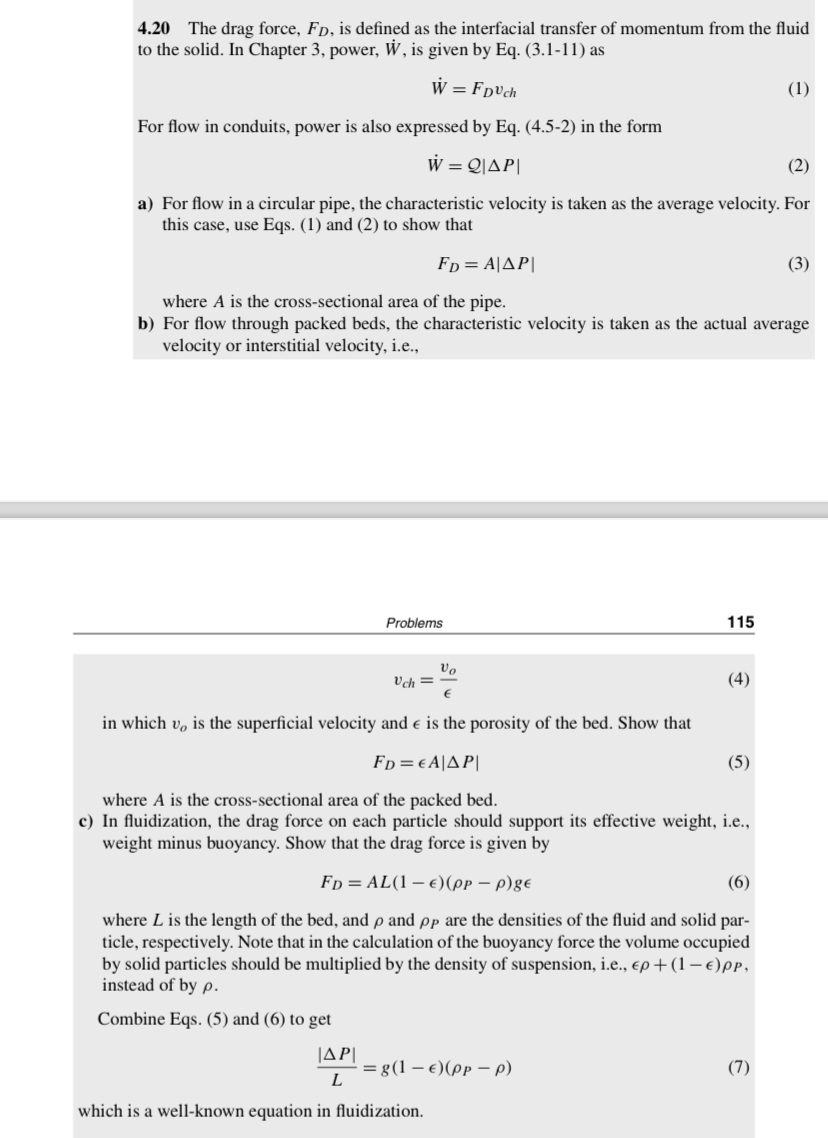
Question: 4 . 2 0 The drag force, F D , is defined as the interfacial transfer of momentum from the fluid to the solid. In
The drag force, is defined as the interfacial transfer of momentum from the fluid to the solid. In Chapter power, is given by Eq as
For flow in conduits, power is also expressed by Eq in the form
a For flow in a circular pipe, the characteristic velocity is taken as the average velocity. For this case, use Eqs. and to show that
where is the crosssectional area of the pipe.
b For flow through packed beds, the characteristic velocity is taken as the actual average velocity or interstitial velocity, ie
Problems
in which is the superficial velocity and is the porosity of the bed. Show that
where is the crosssectional area of the packed bed.
c In fluidization, the drag force on each particle should support its effective weight, ie weight minus buoyancy. Show that the drag force is given by
where is the length of the bed, and and are the densities of the fluid and solid particle, respectively. Note that in the calculation of the buoyancy force the volume occupied by solid particles should be multiplied by the density of suspension, ie instead of by
Combine Eqs. and to get
which is a wellknown equation in fluidization.
Step by Step Solution
There are 3 Steps involved in it
1 Expert Approved Answer
Step: 1 Unlock

Question Has Been Solved by an Expert!
Get step-by-step solutions from verified subject matter experts
Step: 2 Unlock
Step: 3 Unlock
 Study Help