







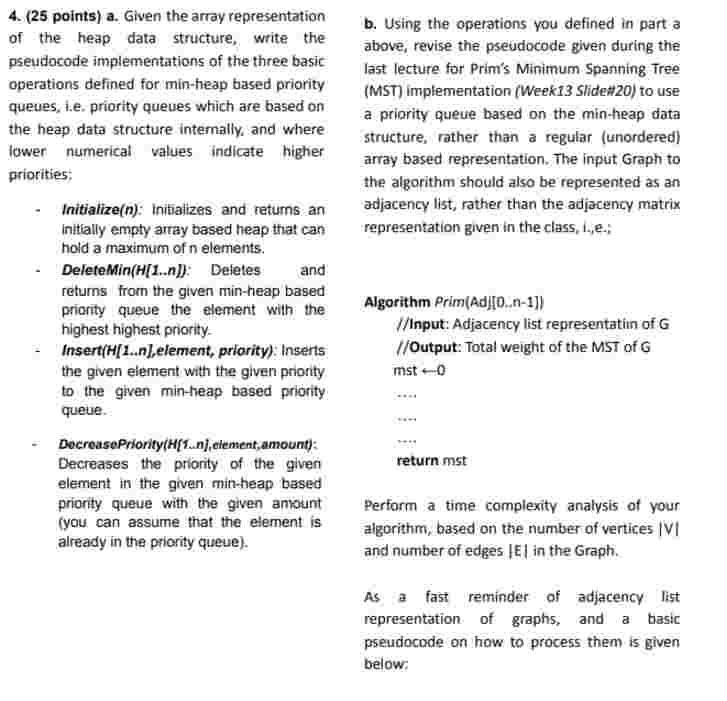
Question: 4 . ( 2 5 points ) a . Given the array representation of the heap data structure, write the pseudocode implementations of the three
points a Given the array representation of the heap data structure, write the pseudocode implementations of the three basic operations defined for minheap based priority queues, ie priority queues which are based on the heap data structure intemally, and where lower numerical values indicate higher priorities;
Initializen: initializes and returns an Initially empty array based heap that can hold a maximum of n elements.
DeleteMinHn: Defetes and returns from the given minheap based priority queue the element with the highest highest priority.
InsertHnelement priority: Inserts the given element with the given prionity to the given minheap based priority queve.
DocreasePtiorityHnelement, amount: Decreases the prionity of the given element in the givan minheap based priority queue with the given amount you can assume that the element is already in the priority queue
b Using the operations you defined in part a above, revise the pseudocode given during the last lecture for Prim's Minimum Spanning Tree MST implementation Week SlideH to use a priority queve based on the minheap data structure, rather than a regular unordered array based representation. The input Graph to the algorithm should also be represented as an adjacency list, rather than the adjacency matrix representation given in the class, ie;
Algorithm PrimAdDn
Input: Adjacency list representatin of G Output: Total weight of the MST of G mathrmmstleftarrow
return mst
Perform a time complexity analysis of your algorithm, based on the number of vertices IVI and number of edges E in the Graph.
As a fast reminder of adjacency Jist representation of graphs; and a basic pseudocode on how to process them is given below:
Step by Step Solution
There are 3 Steps involved in it
1 Expert Approved Answer
Step: 1 Unlock

Question Has Been Solved by an Expert!
Get step-by-step solutions from verified subject matter experts
Step: 2 Unlock
Step: 3 Unlock
 Study Help