







Question: 4. (20 points) Consider the auction model with a continuum of possible valuations. Bidder i's valuation, Vi, is drawn from the uniform distri- bution on
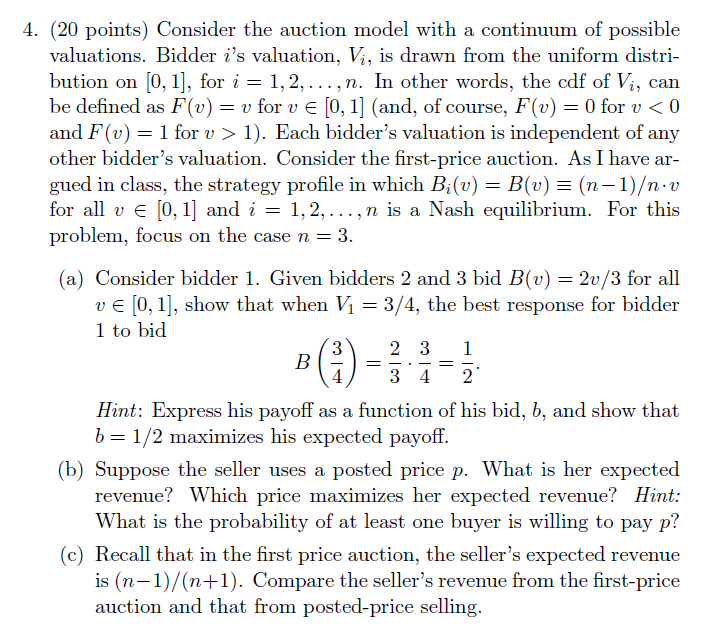
4. (20 points) Consider the auction model with a continuum of possible valuations. Bidder i's valuation, Vi, is drawn from the uniform distri- bution on [0, 1], for i = 1, 2, ..., n. In other words, the cdf of Vi, can be defined as F(v) = v for v [0, 1] (and, of course, F(v) = 0 for v 1). Each bidder's valuation is independent of any other bidder's valuation. Consider the first-price auction. As I have ar- gued in class, the strategy profile in which Bi(v) = B(v) = (n-1).v for all v [0, 1] and i = 1, 2,..., n is a Nash equilibrium. For this problem, focus on the case n = 3. (a) Consider bidder 1. Given bidders 2 and 3 bid B(v) = 20/3 for all ve [0, 1], show that when Vi = 3/4, the best response for bidder 1 to bid 3 2 3 1 B 4. 3 4 2 Hint: Express his payoff as a function of his bid, b, and show that b= 1/2 maximizes his expected payoff. (b) Suppose the seller uses a posted price p. What is her expected revenue? Which price maximizes her expected revenue? Hint: What is the probability of at least one buyer is willing to pay p? (c) Recall that in the first price auction, the seller's expected revenue is (n-1)/(n+1). Compare the seller's revenue from the first-price auction and that from posted-price selling. 4. (20 points) Consider the auction model with a continuum of possible valuations. Bidder i's valuation, Vi, is drawn from the uniform distri- bution on [0, 1], for i = 1, 2, ..., n. In other words, the cdf of Vi, can be defined as F(v) = v for v [0, 1] (and, of course, F(v) = 0 for v 1). Each bidder's valuation is independent of any other bidder's valuation. Consider the first-price auction. As I have ar- gued in class, the strategy profile in which Bi(v) = B(v) = (n-1).v for all v [0, 1] and i = 1, 2,..., n is a Nash equilibrium. For this problem, focus on the case n = 3. (a) Consider bidder 1. Given bidders 2 and 3 bid B(v) = 20/3 for all ve [0, 1], show that when Vi = 3/4, the best response for bidder 1 to bid 3 2 3 1 B 4. 3 4 2 Hint: Express his payoff as a function of his bid, b, and show that b= 1/2 maximizes his expected payoff. (b) Suppose the seller uses a posted price p. What is her expected revenue? Which price maximizes her expected revenue? Hint: What is the probability of at least one buyer is willing to pay p? (c) Recall that in the first price auction, the seller's expected revenue is (n-1)/(n+1). Compare the seller's revenue from the first-price auction and that from posted-price selling
Step by Step Solution
There are 3 Steps involved in it

Get step-by-step solutions from verified subject matter experts
 Study Help