







Question: 4. (20.0 points) To Float or not to Float Consider a floating point system that has 16 bits with 7 bits of exponent and an
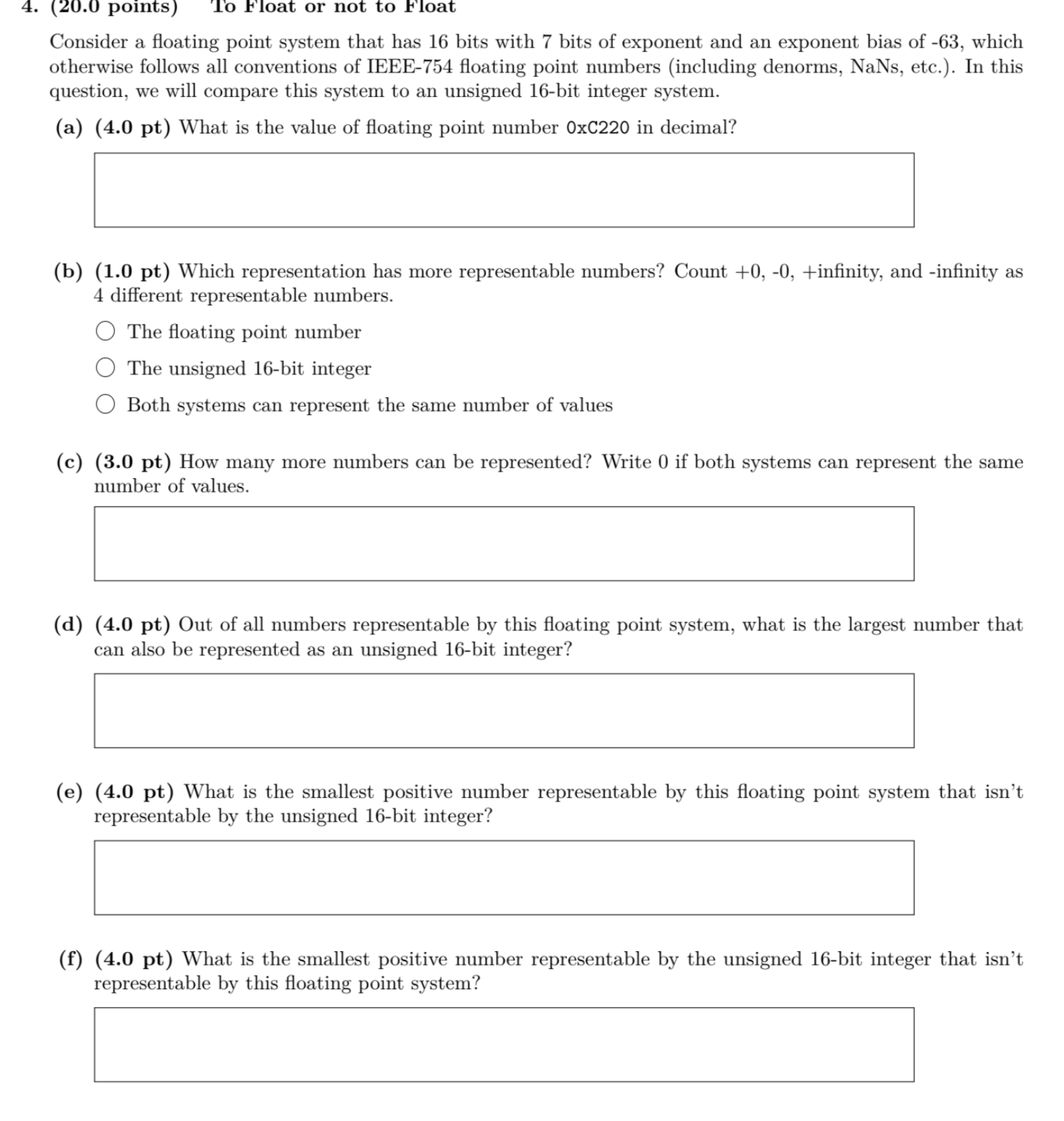
4. (20.0 points) To Float or not to Float Consider a floating point system that has 16 bits with 7 bits of exponent and an exponent bias of -63, which otherwise follows all conventions of IEEE-754 floating point numbers (including denorms, NaNs, etc.). In this question, we will compare this system to an unsigned 16-bit integer system. (a) (4.0 pt) What is the value of floating point number OxC220 in decimal? (b) (1.0 pt) Which representation has more representable numbers? Count +0, -0, +infinity, and -infinity as 4 different representable numbers. The floating point number The unsigned 16-bit integer Both systems can represent the same number of values (c) (3.0 pt) How many more numbers can be represented? Write 0 if both systems can represent the same number of values. (d) (4.0 pt) Out of all numbers representable by this floating point system, what is the largest number that can also be represented as an unsigned 16-bit integer? (e) (4.0 pt) What is the smallest positive number representable by this floating point system that isn't representable by the unsigned 16-bit integer? (f) (4.0 pt) What is the smallest positive number representable by the unsigned 16-bit integer that isn't representable by this floating point system
Step by Step Solution
There are 3 Steps involved in it

Get step-by-step solutions from verified subject matter experts
 Study Help