



Question: 4. [2/3 Points] DETAILS PREVIOUS ANSWERS MY NOTES ASK YOUR TEACHER PRACTICE ANOTHER A single-turn square loop of wire, 2.00 cm on each edge, carries
![4. [2/3 Points] DETAILS PREVIOUS ANSWERS MY NOTES ASK YOUR TEACHER](https://dsd5zvtm8ll6.cloudfront.net/si.experts.images/questions/2024/09/66f699ad66ba0_22966f699ad51c19.jpg)
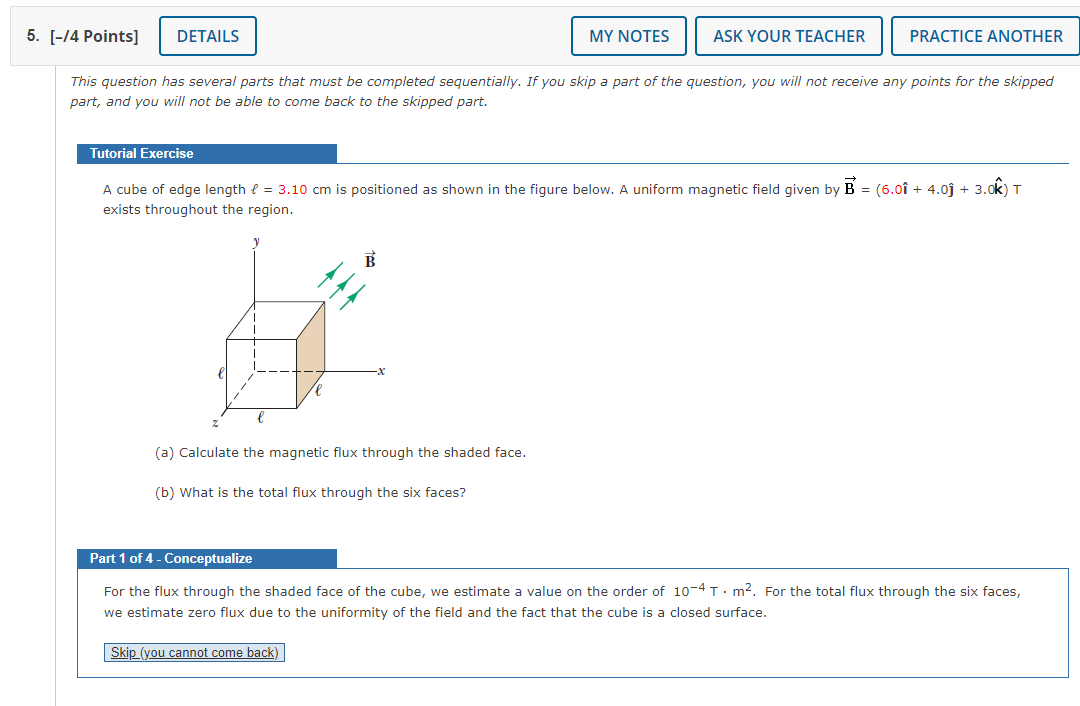
4. [2/3 Points] DETAILS PREVIOUS ANSWERS MY NOTES ASK YOUR TEACHER PRACTICE ANOTHER A single-turn square loop of wire, 2.00 cm on each edge, carries a clockwise current of 0.210 A. The loop is inside a solenoid, with the plane of the loop perpendicular to the magnetic field of the solenoid. The solenoid has 30.0 turns/cm and carries a clockwise current of 15.0 A. (a) Find the force on each side of the loop. magnitude X What is the direction of the magnetic field inside a solenoid. UN direction directed away from the center v| (b) Find the magnitude of the torque acting on the loop. 0 N . m5. [-/4 Points] DETAILS MY NOTES ASK YOUR TEACHER PRACTICE ANOTHER This question has several parts that must be completed sequentially. If you skip a part of the question, you will not receive any points for the skipped part, and you will not be able to come back to the skipped part. Tutorial Exercise A cube of edge length f = 3.10 cm is positioned as shown in the figure below. A uniform magnetic field given by B = (6.01 + 4.0] + 3.0k) T exists throughout the region. (a) Calculate the magnetic flux through the shaded face. (b) What is the total flux through the six faces? Part 1 of 4 - Conceptualize For the flux through the shaded face of the cube, we estimate a value on the order of 1074 T . me. For the total flux through the six faces, we estimate zero flux due to the uniformity of the field and the fact that the cube is a closed surface. Skip (you cannot come back)
Step by Step Solution
There are 3 Steps involved in it

Get step-by-step solutions from verified subject matter experts