



Question: 4. (24 points) You have seen how the geometric distribution can be used to answer a question such as: What is the average number of
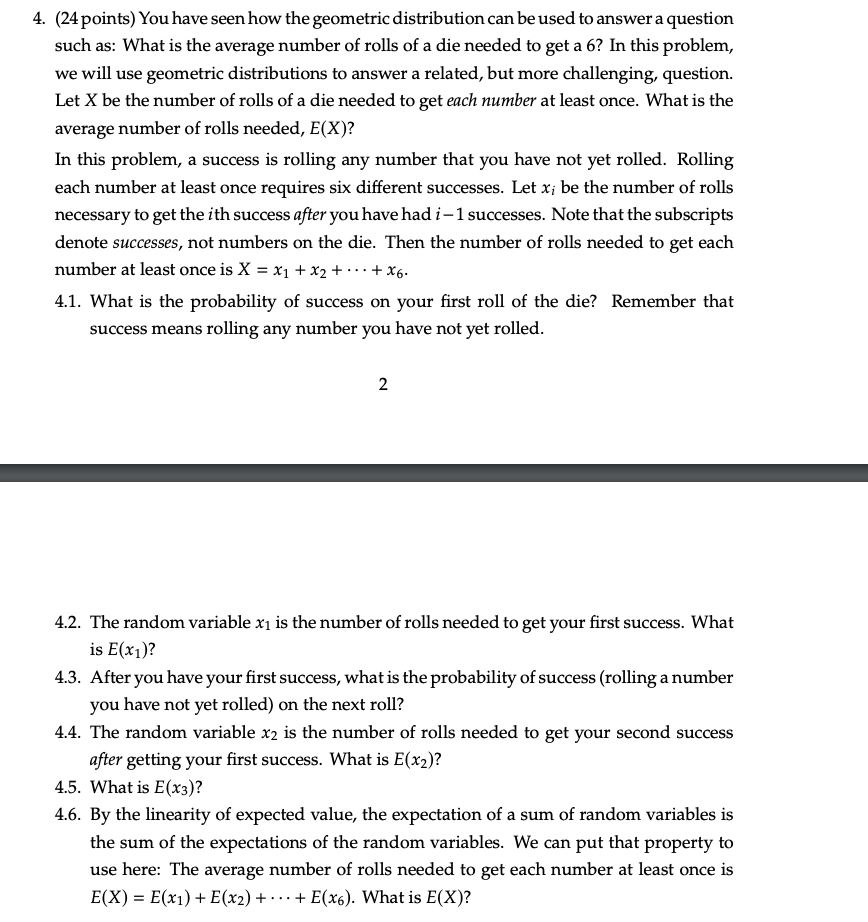
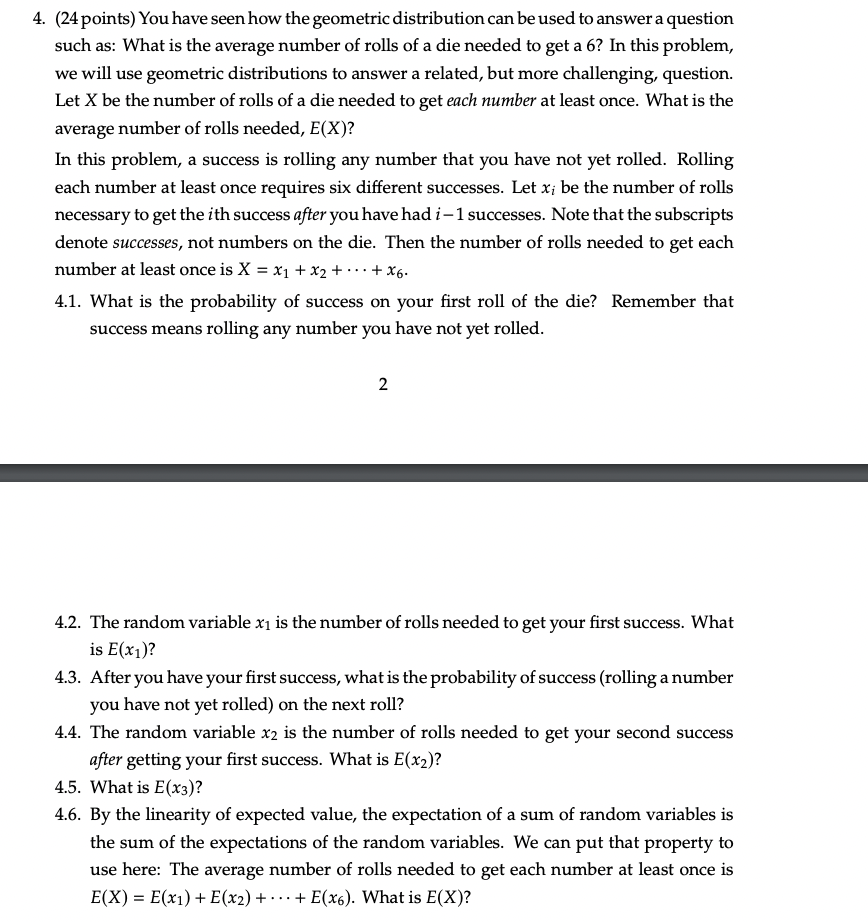
4. (24 points) You have seen how the geometric distribution can be used to answer a question such as: What is the average number of rolls of a die needed to get a 6'? In this problem, we will use geometric distributions to answer a related, but more challenging, question. Let X be the number of rolls of a die needed to get each number at least once. What is the average number of rolls needed, E (X)? In this problem, a success is rolling any number that you have not yet rolled. Rolling each number at least once requires six different successes. Let x.- be the number of rolls necessary to get the ith success aer you have had i 1 successes. Note that the subscripts denote successes, not numbers on the die. Then the number of rolls needed to get each number at least onceis X = x1 +x2 + +x6. 4.1. What is the probability of success on your rst roll of the die? Remember that success means rolling any number you have not yet rolled. 4.2. The random variable :61 is the number of rolls needed to get your rst success. What is E(x1)? 4.3. After you have your rst success, what is the probability of success (rolling a number you have not yet rolled) on the next roll? 4.4. The random variable in is the number of rolls needed to get your second success after getting your rst success. What is E (x2)? 4.5. What is E(x3)? 4.6. By the linearity of expected value, the expectation of a sum of random variables is the sum of the expectations of the random variables. We can put that property to use here: The average number of rolls needed to get each number at least once is 00 = E(x1) +(x2) + - - - + E(x5). What is 130:}
Step by Step Solution
There are 3 Steps involved in it

Get step-by-step solutions from verified subject matter experts